

FOREIGN BUYER GUIDE
Buying Property in Mexico: A Guide for US & Canadian Buyers
Yes, foreigners can buy property in Mexico. But the ownership structure, legal process, closing costs and professionals involved can be very different from what buyers are used to in the US or Canada.
This guide explains the complete process in plain English, from choosing a property and making an offer to due diligence, fideicomisos, closing and taking ownership.
Can Foreigners Buy Property in Mexico?
Yes. Foreigners can acquire property in Mexico. Outside the restricted zone, foreign buyers may generally hold title directly, subject to applicable law and requirements.
Within Mexico's restricted zone - 50 kilometers from the coastline and 100 kilometers from an international border, foreign buyers typically use a Mexican bank trust called a fideicomiso. The foreign buyer is the beneficiary of the trust and recieves full ownership rights to use, enjoy, transfer and pass on those beneficial rights, subject to the trust terms and Mexican law.
Can foreigners buy?
Yes
Residency Required?
Not to simply purchase property
Coastal property?
Often held through a fideicomiso
Fideicomiso term?
Up to 50 years per authorization
Notario involved?
Yes, in formalizaing and qualifying real estate transactions
Can I sell later?
Yes
Answers You'll Find on This Page
Can foreigners buy property?
The restricted zone
What is a fideicomiso?
The buying process
Making an offer
Deposits and escrow
Due diligence
What does the Notario do?
Closing costs
Property taxes and ongoing costs
Financing
Buying new construction
Buying land
Buying remotely
Common mistakes
Frequently asked questions
La Paz's world-famous malecón and the Sea of Cortez

What is Mexico's Restricted Zone?
Mexico's Constitution limits direct foreign ownership of land within 100 kilometers of an international border and 50 kilometers of the coastline.
Because much of Baja California Sur, including La Paz, lies within the restricted zone, foreign residential buyers commonly use a fideicomiso to hold their property rights.
Why this matters in Baja California Sur
For most foreign buyers considering a home or condo in La Paz and other coastal areas of Baja California Sur, the restricted zone rules are not a side-issue...they are part of the normal ownership process.
That is why understanding the fideicomiso before you begin looking at property can remove a lot of unnecessary confusion later.
What is a Fideicomiso?
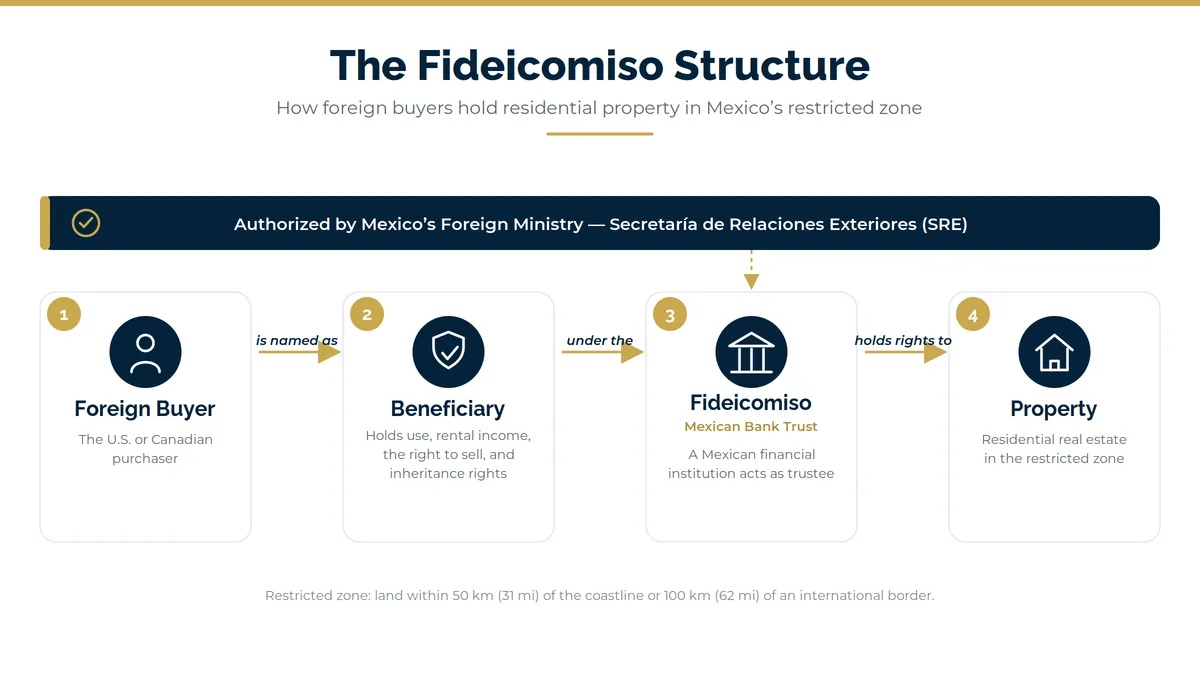
A fideicomiso is a trust arrangement authorized for qualifying property in Mexico's restricted zone. A Mexican financial institution acts as a trustee, while the foreign buyer is named as beneficiary.
For residential property in the restricted zone, the Foreign Ministry issues the authorization that allows the trust to hold rights over the property for the benefit of the foreign buyer.
With a fideicomiso, you can:
Sell it.
Renew indefinitely.
Renovate.
Subdivide.
Pass it on.
You have FULL ownership rights.
THE BUYING PROCESS
How Buying Property in Mexico Works
1. Define your goals and budget
Location, property type, lifestyle, investment goals
2. Search and evaluate property
MLS, neighborhoods, title context, condition
3. Make an offer
Terms, price, contingencies, timing
4. Deposit / escrow
Funds handled according to the agreed transaction structure
5. Due diligence
Ownership, title, liens, permits and supporting documentation are reviewed
6. Notarial and trust process
The transaction documents, government requirements and fideicomiso steps are completed
7. Closing and Possession
Final signatures, payment, registration completion and possession

WORKING WITH DREAM BAJA REALTY
Where Dream Baja Realty Fits Into the Process

Our role is to help you navigate the real estate side of the transaction from the first property search through closing.
That includes helping you evaluate neighborhoods and properties, understand the offer process, coordinate with the professionals involved in the transaction, track key milestones and make sure you know what questions to ask along the way.
We are not a substitute for your attorney, tax advisor, notario or other licensed professional. When specialist advice is required, we know the right professional to get involved.
Making an Offer on Property in Mexico
The offer stage establishes the commercial terms of the transaction: price, deposit, timing, inclusions, contingencies and other negotiated conditions.
The exact documentation and process can vary by property and transaction, so buyers should understand what they are signing, which terms are binding, and what conditions must be satisfied before closing.
Questions to ask before signing:
What exactly is included in the sale?
What deposit is required?
Where will funds be held?
What due-diligence conditions apply?
What happens if title or documentation problems appear?
What is the expected closing timeline?
Which costs are the buyer's responsibility?

How Do Deposits and Escrow Work?
The way deposits and transaction funds are handled should be clearly documented before money is transferred.
Depending on the transaction, parties may use an escrow arrangement or another agreed structure. Buyers should understand who is holding the funds, the conditions for release, and what happens if the transaction doesn't close.
Dream Baja Realty rule of thumb:
Never send significant transaction funds simple because someone emailed wire instructions. We advise our clients to use third party escrow to protect their money, and to independently verify recipient details and the transaction process before sending money.
What Due Diligence Should a Buyer Expect?
Finding a property you love is only the first half of the job. Before closing, the legal and physical reality fo the property needs to match what you believe you're buying.
Seller identity and authority to sell.
Property ownership / title documentation
Liens or encumberances
Property
boundaries
Taxes and fees
Permits / construction documentation
Condo / HOA documentation where relevant
Utilities and services
Fideicomiso status if applicable
Property condition / inspections where applicable
What Does a Notario Publico Do?
A Mexican Notario Publico is a specially appointed legal professional who plays a formal role in many real estate transactions, including preparing or authenticating transaction documents, confirming required legal formalities and helping complete the transfer and registration process.
A notario is NOT the Mexican equivalent of a US-style document-signing notary.
Important:
The notario's role in the transaction is impartial, which means they are not necessarily acting as your personal advocate in the same way your own attorney would. We always advise retaining your own closing attorney.
How Much Are Closing Costs When Buying in Mexico?
Closing costs are separate from the purchase price and can vary based on the property value, location, ownership structure and individual transaction.
Potential costs can include acquisition taxes, notarial expenses, registration, government permits, fideicomiso-related expenses and other professional or transaction fees.
Try our Closing Costs Calculator
Mexico Closing Cost
Calculator
See every cost before you sign. Get a real total in under 60 seconds — no surprises at the notario's office.
Calculator results are estimates, not final closing statements
What Does It Cost to Own Property After Closing?
Property Tax
You're going to be pleasantly surprised. Many owners pay in a full year what they might owe in a month back home.
Fideicomiso administration
Paid annually directly to your trustee bank. Generally between $400 and $600 USD per year in La Paz.
HOA fees
If in a condo or building development. The amount of monthly or annual HOA fees should be asked prior to committing to the sale.
Insurance
Basic home insurance rates are very reasonable, though this number can climb when adding riders for flooding or hurricanes.
Utilities
Utility costs vary per city and state - but are generally very reasonable. Note that you can dramatically increase your electricity bill in the summer with excessive AC use.
Maintenance
Pool, landscaping, repairs, property management. We can help you investigate costs and connect you with recommended experts.
Can Foreign Buyers Finance Property in Mexico?
Financing options do exist, but the Mexican mortgage market and terms available to foreign buyers can differ significantly from what US or Canadian buyers are accustomed to.
Many Baja transactions are still completed with cash or alternative financing arrangements, while some buyers use Mexican lenders, cross-border lending products or developer financing where available.
Buying New Construction in Baja
Pre-construction can offer attractive opportunities, but it also creates a different risk profile from buying a completed resale property. The buyer is evaluating not just a home, but the developer, contracts, approvals, construction schedule and promised delivery.
We help you check:
Developer track record
We help you check:
Permits
We help you check:
Construction timeline
We help you check:
Deposit schedule
We help you check:
Specifications
We help you check:
HOA/Common areas
We help you check:
Delivery conditions
We help you check:
Title / trust timing
Common Mistakes We Want Buyers to Avoid
Falling in love before doing due diligence
A beautiful view does not cure a documentation problem.
Assuming Mexico works like the US or Canada
Different professionals and processes have different roles.
Budgeting only for the purchase price
Closing and ongoing ownership costs matter.
Sending money without verifying instructions
Wire fraud is a real-world transaction risk.
Treating a fideicomiso as something scary or mysterious
Understand it before deciding whether it is a problem.
Buying land without understanding its legal status
Not every lot or parcel is equivalent.
Skipping professional advice because "everyone does it this way"
Custom and legality are not the same thing.
Choosing a neighborhood only from vacation experience
Living somewhere and vacationing somewhere are different.
Buying in La Paz Is the Next Level of the Decision
Once you understand how buying property in Mexico works, the next question is much more local: what should you buy, where should you buy it, and what does the La Paz market actually look like?
Neighborhoods, property types, utilities, new construction, pricing and lifestyle can vary significantly across the La Paz area.
Frequently Asked Questions about Real Estate in Mexico
Can a US citizen buy a house in Mexico?
Yes. US citizens can legally buy property in Mexico, and you do not need to be a Mexican resident or citizen to own real estate. Outside Mexico's "restricted zone", foreigners can generally hold title directly in their own name. Inside the restricted zone (within 50 km of the coastline or 100 km of an international border) residential property is typically held through a fideicomiso, or bank trust. The buyer still controls the property, including the right to live in it, rent it, improve it, sell it, or leave it to beneficiaries.
Can a Canadian buy property in Mexico?
Yes, Canadian citizens can purchase property in Mexico under essentially the same rules as other foreign buyers. Mexican residency is not required to simple own a home. If the property is outside the restricted zone, a Canadian buyer can generally take direct title. If it is within 50 km of the coast or 100 km of an international border, residential property is normally acquired through a fideicomiso. This is particularly common through Baja California Sur. The foreign buyer is named as beneficiary of the trust and retains all rights of ownership.
Do I need Mexican residency?
No. You do not need temporary or permanent Mexican residency to purchase and own real estate in Mexico. Foreigners can buy property while entering Mexico as visitors, provided the transaction complies with Mexican law. Residency and property ownership are separate legal matters. That said, residency may become useful if you plan to live in Mexico full-time, register vehicles, access certain services, open some types of financial accounts, or establish Mexico as your primary home. Buying property does not automatically give you residency, nor does obtaining residency automatically give you any special property ownership rights.
Can foreigners own beachfront property?
Yes, but usually through a fideicomiso. Mexico's constitution restricts foreigners from directly holding residential title within 50 km of the coastline and 100 km of an international border. This area is known as the restricted zone. Instead, a Mexican bank holds legal title as trustee while the foreign purchaser is named the beneficiary. The beneficiary can occupy, renovate, rent, sell, mortgage, or pass the property to designated beneficiaries. Importantly, buying "beachfront" property does not mean you own the federal maritime zone itself; Mexico maintains public and federal rights along the immediate shoreline.
Is a fideicomiso safe?
A properly established fideicomiso is a standard and widely used legal structure for foreign residential ownership in Mexico's restricted zone. The Mexican bank acts as trustee, but it does not own the property for its own benefit and cannot use or sell it. The foreign buyer is the beneficiary and directs what happens with the property according to the trust agreement. The fideicomiso is also separate from the bank's own assets. As with any real estate purchase, safety depends on proper due diligence, clear title, qualified legal and notarial review, and ensuring the trust is correctly established and registered.
How long does a fideicomiso last?
A residential fideicomiso is generally established for a term of 50 years. That does NOT mean you lose the property after 50 years. The trust can be renewed for additional 50-year periods, allowing ownership rights to continue. The trust can also be transferred to a new buyer if you sell the property, and you can name substitute beneficiaries who can receive your rights in the event of your death. There is normally an initial set up cost as well as an annual trustee fee charged by the bank for the administering of the fideicomiso.
How long does closing take?
A typical Mexican real estate closing can take approximately 60-90 days, although some transactions close faster and others take longer. Timing depends on factors such as whether a fideicomiso is required, title documentation, certificates and municipal records, financing, foreign investment permits, seller tax calculations, and the workload of the Notario Publico. In Mexico, the Notary plays a central legal role in transferring title and registering the transaction. Buyers should avoid assuming a U.S. or Canadian-style closing timeline; allowing adequate time for legal and governmental processing helps prevent unnecessary pressure or surprises.
Can I buy remotely?
Yes. Many foreign buyers purchase Mexican property without being physically present for every stage of the transaction. Offers, contracts, escrow arrangements, document review, inspections, and much of the due diligence process can be handled electronically and by your Dream Baja Realty licensed agent. When signatures or closing documents require formal representation, a buyer can often grant a properly executed power of attorney to a trusted representative in Mexico. Depending on where it is signed, the document may need notarization, an apostille, and Spanish translation. Remote purchases are common, but buyers should still use reputable professionals and independently verify important documents, wiring instructions, and property details.
Thinking About Buying in Baja?
Whether you're ready to start looking or still trying to understand how the process works, we're happy to help you figure out the next step.
Dream Baja Realty
Calle Delfines 135
entre Mangle y Oceano Pacifico,
Col. Esperanza I, La Paz, 23090 Mexico
Limitation of Liability: Dream Baja Realty, is a real estate company that offers third party real estate, therefore all information published on this site, is deemed reliable but not guaranteed and should be verified with one of our advisers in order to confirm whether the advertised properties are subject to lease, sale, change or withdrawal. Dream Baja Realty will not be responsible for any typographical errors, misinformation, misprints and in no case be considered as misleading advertising or bad faith. Dream Baja Realty is a proud member of MLS BCS. Please enjoy this website advertising all brokerage members MLS listings for public review.
The offered price is in DOLLARS (US Currency) and in accordance with article 8 of the monetary law, the final price for recordation purposes will be converted into PESOS resulting from the official exchange rate on the date payment is due. Prices shown in DOLLARS can be converted into PESOS by accessing the following link and performing the corresponding arithmetic multiplication per the current exchange rate. https://www.banxico.org.mx/tipcamb/main.do?page=tip&idioma=en