

BUYING PROPERTY IN MEXICO
Closing Costs in Mexico: What Property Buyers Should Expect
Buying property in Mexico involves more than the agreed purchase price. Buyers should also budget for acquisition tax, Notary fees, registration, certificates, permits and - when applicable - fideicomiso costs. In Baja California Sur, total buyer closing costs can represent a meaningful percentage of the purchase price, so understanding them before making an offer can help you budget properly and avoid surprises at closing.
The good news: these costs can be estimated well before you commit to the purchase.
THE SHORT ANSWER
How Much Are Closing Costs When Buying Property in Mexico?
Buyer closing costs in Mexico commonly include several separate taxes, government charges and professional fees rather than one single "closing fee." The total depends on the property's purchase price, assessed value, location, ownership structure and the specific transaction. A foreign buyer purchasing residential property in coastal Baja may also need to include the cost of establishing or transferring a fideicomiso. Because several charges are calculated as percentages or according to government schedules, the best approach is to obtain a property-specific closing-cost estimate before signing or removing important contingencies.
In plain English: don't guess. Ask for a closing-cost estimate before deciding what you can comfortably spend on the property.
WHERE THE MONEY GOES
What Closing Costs Does a Buyer Pay in Mexico?
There isn't one single closing-cost charge in a Mexican property purchase. Your closing statement normally combines several taxes, government fees and transaction expenses.
1. Property Acquisition Tax
ACQUISITION TAX
Buyers pay the Mexican version of a "transfer tax" when acquiring real estate in Mexico. In Baja California Sur, the rate is 3% of the purchase price of the property.
This of this as the Mexican equivalent of a property-transfer tax.
2. Notary Fees
MEXICAN NOTARY FEES
A Mexican Notary Public plays a central role in transferring real estate, including formalizing the deed and coordinating various closing requirements.
The Notary isn't optional - the Notary is part of how legal title is transferred in Mexico.
3. Public Regsitration
PROPERTY REGISTRATION
The completed deed and ownership rights must be registered with the appropriate Public Registry of Property.
This is what puts the completed transaction into the official property record.
4. Certificates & Gov't Documents
CERTIFICATES AND ADMINISTRATIVE FEES
A closing may require certificates, searches, appraisals, tax records and other government documentation depending on the property and transaction.
These are the smaller pieces that make sure the paperwork is complete before ownership changes hands.
5. Fideicomiso
FIDEICOMISO COSTS
Foreign buyers purchasing residential property within Mexico's restricted coastal or border zone may have costs associated with creating, modifying or transferring a fideicomiso.
When you're buying a home near the coast, simply plan for the fideicomiso as one normal part of the transaction.
6. Transaction Services
CLOSING, ESCROW AND PROFESSIONAL SERVICES
Depending on the transaction, buyers may also use escrow, legal counsel, closing coordinators, translators or other professional services.
These professionals help protect the transaction and keep the money and documentation moving correctly.
WHY THEY'RE DIFFERENT
Why Do Closing Costs in Mexico Seem High?
Buyers from the United States and Canada sometimes compare Mexican closing costs directly with the costs of purchasing property back home. The systems are different. A Mexican real estate closing can bundle together property acquisition tax, Notary work, government permits, registration charges, certificates and ownership-structure costs that may be handled differently, or appear under different categories, in another country.
That can make the percentage initially look high, but these aren't simply fees being added by the real estate brokerage. Many are taxes, government charges and legal expenses required to complete and register the transaction.
In plain English: you aren't paying one giant fee - you're paying several different costs that all come together at closing.
BUDGETING
What Percentage Should I Budget for Closing Costs?
There is no single percentage that applies to every Mexican property purchase. As a planning tool rather than a closing quote, foreign buyers in Baja California Sur are often wise to reserve a meaningful percentage above the purchase price for closing expenses, particularly when a new fideicomiso is required. Lower-priced properties can sometimes show a higher closing-cost percentage because several transaction expenses are relatively fixed, while on higher-value properties those same costs may represent a smaller percentage of the property price.
The only reliable way to know your likely cost is to calculate it using the specific property, purchase price and proposed ownership structure.
Don't choose your maximum purchase price first and worry about closing costs later. Budget for both from the beginning.
If I have $500,000 USD to spend, should I shop for a $500,000 property?
Probably not if $500,000 represents your entire available budget. You should leave room for closing costs and any immediate ownership expenses so that your purchase price plus transaction costs stay within your comfortable total budget.
The safe approach is to decide your total budget first, then work backward to the right property price.
REAL-WORLD EXAMPLE
What Might Closing Costs Look Like on a La Paz Home?
Let's look at a simplified example of a buyer purchasing a $425,000 USD residential property in La Paz.
This is an illustration, not an official closing quote. The final numbers will depend on the peso value used for the transaction, the property's taxable value, ownership structure, Notary calculations, trustee bank and services required.
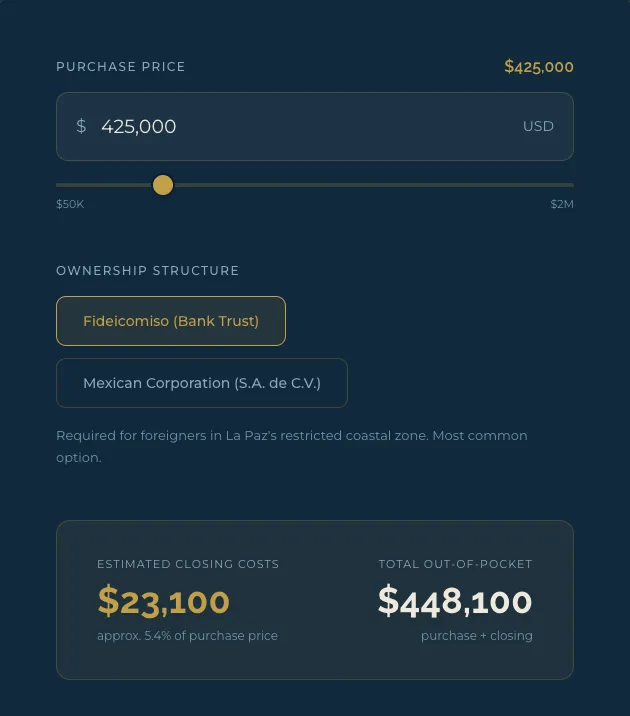
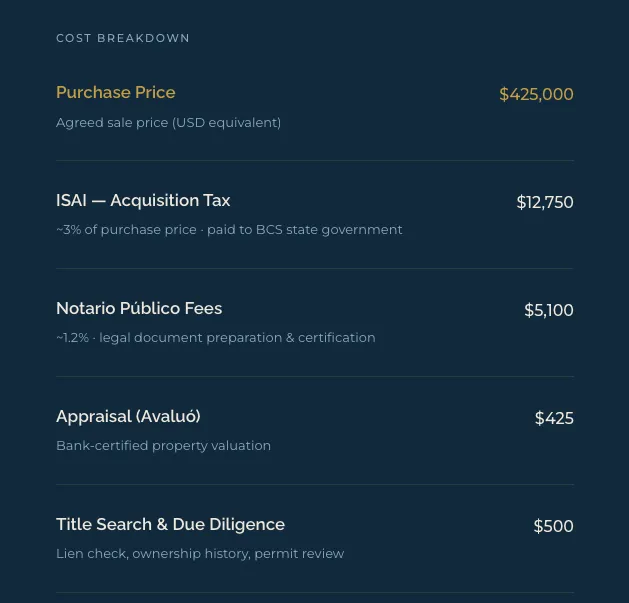
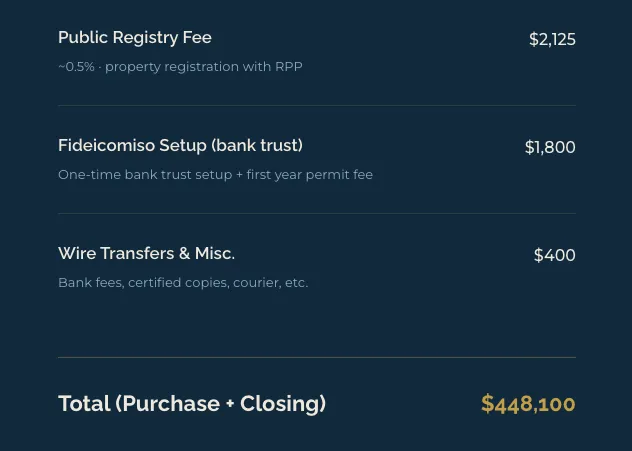
A $425,000 property does not mean you need only $425,000 to complete the purchase. Your real budget needs to include the property plus the costs of legally closing and registering it.
The good news: we can estimate these costs before you make the purchase, so there shouldn't be a big surprise at closing.
Want to Calculate Your Own Purchase?
Enter the property price your are considering and get a quick planning estimate of your potential Baja California Sur closing costs.
Mexico Closing Cost
Calculator
See every cost before you sign. Get a real total in under 60 seconds — no surprises at the notario's office.
PROPERTY ACQUISITION TAX
What is the Property Acquisition Tax in La Paz?
When real estate changes ownership in Baja California Sur, the buyer is generally responsible for the municipal Impuesto Sobre Adquisicion de Bienes Inmuebles, commonly referred to as ISABI. Under the Municipality of La Paz's Hacienda law, the person or entity acquiring the real estate is the taxpayer responsible for this acquisition tax. The current statutory rate is 3% of the applicable property value.
In plain English: La Paz (and Cabo, Loreto, Todos Santos...every municipality in Baja California Sur) charges a local property-transfer tax when you buy, and the exact amount should be calculated for your specific property rather than simply estimated from the asking price.
ACQUISITION TAX ≠ ANNUAL PROPERTY TAX
Acquisition tax (ISABI) is associated with acquiring the property.
Property tax (predial) is the recurring municipal property tax paid during ownership.
They are two different expenses.
Think of ISABI as a buying cost and predial as an ownership cost.
NOTARIO & REGISTRATION
What Other Closing Costs Should Buyers Expect?
Beyond acquisition tax, a real estate closing in Mexico includes a number of legal, administrative and registration expenses.
These are typically coordinated through the Notario Publico handling the transaction.
Depending on the property and transaction, costs that may be included in your closing costs:
Notario fees
Public Registry filing and registration
Property appraisal
Certificates confirming property status
No-lien and no-debt certificates
Cadastral (property tax ID) documentation
Municipal documentation
Permits and government fees
Translation or power power-of-attorney expenses when required
Rather than thinking of each one as a separate surprise expense, it is better to consider them part of your overall closing-cost budget.
In simple terms: your Notario helps bring all the legal pieces together so the property can be properly transferred and registered in your name.
Important:
A Mexican Notario Publico is not simply the Mexican equivalent of a U.S. or Canadian notary. A Notario is a highly qualified legal professional authorized by the government to formalize property transfers and ensure applicable requirements are satisfied.
Learn more about the Notario Publico
FOREIGN BUYERS
How Much Does a Fideicomiso Add to Closing Costs?
If you are a foreign buyer purchasing residential property within Mexico's restricted zone - generally within 50 kilometers of the coastline or 100 kilometers of an international border - you will normally acquire the property through a fideicomiso, or Mexican bank trust.
For a new fideicomiso, buyers should expect additional setup expenses associated with establishing the trust and obtaining the required authorization - these fees will be included in your closing costs. A reasonable planning estimate for the fideicomiso portion of the closing (establishment of the trust and legal fees) is approximately $2000 - $3000 USD.
Want to understand exactly how a fideicomiso works? Read our Complete Fideicomiso Guide
Remember: the bank does not own your home for its own benefit. As beneficiary of the fideicomiso, you retain the beneficial rights to use, improve, rent, sell and pass the property on to your designated beneficiaries or heirs, subject to the terms of the trust and applicable laws.
WHO PAYS WHAT?
Which Closing Costs Does the Buyer Pay in Mexico?
In a typical Baja California Sur resale transaction, the buyer and seller are responsible for different expenses.
Buyer Typically Pays
Acquisition tax
Notario and registration expenses related to acquisition
Fideicomiso setup, when required
Appraisal and certificates associated with acquisition
Certain permits and government fees
Buyer legal or due-diligence services, if separately retained
Seller Typically Pays
Applicable capital-gains / income tax
Seller-side tax calculations
Real estate commission
Outstanding property obligations that must be cleared
Other seller-specific transaction expenses
Seller legal services, if separately retained
These are general transaction conventions, not universal rules. The signed purchase agreement ultimately establishes the obligations of the parties, and the Notario calculates the applicable taxes and formal closing expenses.
The BCS government confirms that the Notario calculates and remits applicable seller income tax arising from a real estate transaction.
In simple terms: as a buyer, you normally budget for the cost of acquiring and registering the property; the seller normally deals with taxes and expenses, including sales commissions, associated with selling it.
PROPERTY TYPE
Are Closing Costs Different for New Construction?
They can be.
When buying a resale property, the purchase usually involves transferring an existing title from the current owner to the buyer.
A new-construction purchase may involve additional considerations such as:
Developer contract structure
Construction completion status
Condominium regime documentation
Delivery and possession
Utility connections
Developer-provided warranties
Applicable tax treatment
Timing of title transfer
Creation of a new fideicomiso rather than assignment of an existing one
Because every development is structured differently, buyers should never assume the same purchase process and procedures will apply to every new-construction purchase.

Buying pre-construction?
Ask for an estimated closing-cost sheet before signing the purchase contract, not shortly before delivery of the property.
TIMING
When Are Closing Costs Paid?
Most closing expenses are not paid the day you submit an offer.
The process generally develops in stages:
1. Offer Accepted
The buyer and seller agree on price and principal terms.
2. Earnest money deposited
The agreed deposit is sent according to the purchase agreement, commonly through escrow.
3. 50% of the estimated closing costs deposited
50% of the estimated closing costs are sent to the closing attorney or Notary, depending on how the transaction is structured
4. Due diligence and closing preparation
The legal team, Notario and other professionals collect and review the documents required for closing.
5. Closing statement prepared
As closing approaches, the buyer receives the calculation of the funds required to complete the purchase - approximately the remaining 50% of the closing costs estimate.
6. Buyer funds
The purchase balance and applicable and remaining closing expenses are transferred according to the transaction instructions.
7. Title is formalized and registered
The Notario completes the deed process and the transaction proceeds through the required registration procedures.
In simple terms: you should know your approximate closing budget before you make an offer, even though the exact amount is normally formalized later in the transaction.
BUDGETING
Can I Finance My Closing Costs in Mexico?
Usually, buyers should plan to have their closing costs available in addition to their down payment or purchase funds. If you are obtaining financing, the availability of financing for closing expenses depends entirely on the lender and loan structure.
For cash buyers, closing expenses should simply be included in your total acquisition budget from the beginning.
Shop for the property based on your total available budget, not just the asking price.
CLOSING COSTS FAQs
Frequently Asked Questions About Closing Costs in Mexico
How much should I budget for closing costs when buying in Baja California Sur?
As a general planning guideline, many buyers budget approximately 4% - 8% of the purchase price for closing expenses. The actual amount depends on the property's value, acquisition tax, Notario and registration costs, whether a fideicomiso is required, and the specifics of the transaction.
The simple version: leave room in your budget beyond the purchase price and get a transaction-specific estimate before committing.
What is the property acquisition tax in Baja California Sur?
For planning purposes, we use a 3% acquisition tax rate for Baja California Sur transactions. Your Notario will determine the actual taxable base and final amount applicable to your transaction.
The simple version: acquisition tax is one of the biggest buyer closing expenses, so build it into your budget from day one.
Are closing costs negotiable in Mexico?
Some professional fees may vary, but many closing expenses are taxes, government charges, registration expenses or transaction-specific costs rather than negotiable fees. The allocation of certain expenses between buyer and seller can also depend on the purchase agreement.
The simple version: don't base your purchase on the assumption that you'll negotiate thousands off the closing costs.
Do foreigners pay higher closing costs than Mexican buyers?
Foreign buyers do not simply pay a higher tax because they're foreigners. However, when purchasing residential property in Mexico's restricted zone, a foreign buyer will normally have the additional cost of establishing or acquiring through a fideicomiso.
The simple version: the biggest additional foreign-buyer expense is usually the trust structure, not a special foreigner tax.
Do I need a fideicomiso in La Paz?
For most foreign individuals purchasing residential property in La Paz, yes. La Paz lies within Mexico's constitutionally defined restricted zone because of its proximity to the coast.
The fideicomiso allows foreign buyers to buy real estate within the restricted zone.
The simple version: the biggest additional foreign-buyer expense is usually the trust structure, not a special foreigner tax.
Who calculates my final closing costs?
The Notario Publico handling the transaction coordinates the final closing and determines the applicable taxes, registration expenses and many of the official closing charges.
Your real estate and closing team can provide estimates earlier in the process so you can budget appropriately.
The simple version: we can help you estimate early; the Notario provides the transaction-specific numbers.
When will I know the exact amount I need for closing?
An initial estimate can normally be prepared well before closing, while the final closing statement is produced once the necessary valuations, certificates, calculations and transaction details are available.
The simple version: you shouldn't be guessing at closing costs when you make an offer, even though the exact number comes later.
Can Dream Baja Realty estimate closing costs before I make an offer?
Yes. We can help you develop a reasonable planning estimate based on the property price, location and anticipated ownership structure.
An estimate is extremely useful when determining how much property you can comfortably afford. A regular part of our process is to additional get a closing costs estimate from a local closing attorney prior to submitting an offer on your behalf.
The simple version: send us the property and price and we'll help you understand the likely total investment before you commit.
BUY WITH CLARITY
Know the Real Cost Before You Buy
The purchase price is only one part of buying property in Mexico.
Dream Baja Realty help American, Canadian and international buyers understand the entire transaction - from property search and negotiation through fideicomiso, escrow, due diligence and closing.
Whether you have already found a property or are just beginning your search, we'll help you understand the numbers before you make a committment.
Continue Your Baja Buying Research
Buying Property in La Paz
The complete foreign buyer's guide to purchasing real estate in Baja California Sur.
Understanding the Fideicomiso
Learn how foreigners legally own property near Mexico's coastline.
The Mexico Property Buying Process
Follow the transaction from property search through keys and registration.
Escrow When Buying in Mexico
Understand how deposits and purchase funds are handled during the transaction.
Dream Baja Realty
Calle Delfines 135
entre Mangle y Oceano Pacifico,
Col. Esperanza I, La Paz, 23090 Mexico
Limitation of Liability: Dream Baja Realty, is a real estate company that offers third party real estate, therefore all information published on this site, is deemed reliable but not guaranteed and should be verified with one of our advisers in order to confirm whether the advertised properties are subject to lease, sale, change or withdrawal. Dream Baja Realty will not be responsible for any typographical errors, misinformation, misprints and in no case be considered as misleading advertising or bad faith. Dream Baja Realty is a proud member of MLS BCS. Please enjoy this website advertising all brokerage members MLS listings for public review.
The offered price is in DOLLARS (US Currency) and in accordance with article 8 of the monetary law, the final price for recordation purposes will be converted into PESOS resulting from the official exchange rate on the date payment is due. Prices shown in DOLLARS can be converted into PESOS by accessing the following link and performing the corresponding arithmetic multiplication per the current exchange rate. https://www.banxico.org.mx/tipcamb/main.do?page=tip&idioma=en