How to Buy Pre-Construction in Mexico: A Step-by-Step Guide for Americans and Canadians
TL;DR
Buying pre-construction in Mexico means paying for a home before it exists, usually in stages, in exchange for a lower price and first pick of units. The process runs from vetting the developer, to a reservation and purchase contract, to a payment schedule during construction, and finally to delivery and closing before a notary (a Notario Público). Done carefully, with real due diligence and the right professionals, it's one of the smartest ways to buy in Baja California Sur. Done casually, it's where most of the horror stories come from.

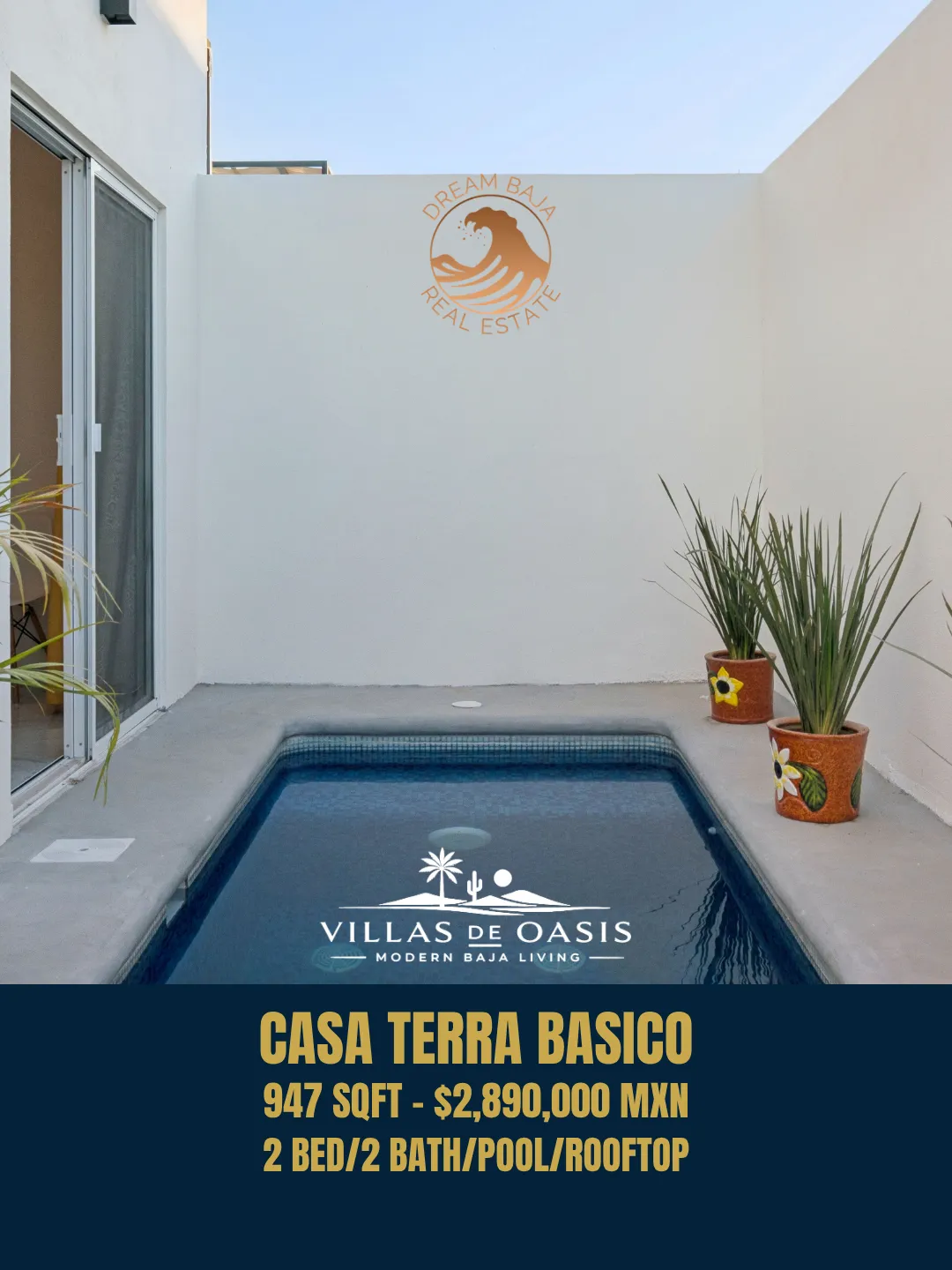
Explore Villas de Oasis: A Pre-Construction Success Story and an amazing opportunity
Buying a Home That Doesn't Exist Yet
The first time you walk a pre-construction site in La Paz, it rarely looks like a dream home. It looks like rebar and dust. A security guard waves from a plastic chair under a palapa. There's a cement mixer grinding away, a radio playing banda somewhere behind the formwork, and a sales office with cold water, a scale model under glass, and a rendering of a rooftop pool that is, for now, very much theoretical.
And yet some of the best purchases I've seen clients make started exactly like that.
Pre-construction (in Spanish, preventa) is how a large share of new condos and homes in Baja California Sur get sold. Developers sell units early, often at meaningful discounts, to fund construction and prove demand. Buyers get a lower entry price, their choice of floor and view, and the chance to own something brand new in a market where quality new inventory doesn't sit around for long.
Let's have the honest conversation, though. You're buying a promise. The process exists to turn that promise into a deed (an escritura) with your name attached, and every step below is about protecting you along the way. Here's how it actually works.
What Pre-Construction Really Means in Mexico
Most developments in Baja California Sur sell in phases. The earliest buyers, sometimes before the ground is even broken, get the lowest prices. As construction progresses and risk drops, prices step up. By the time the building is finished, the last units often sell for noticeably more than the first ones did.
That price gap is the reward for taking on risk. And the risk is real, so it's worth naming plainly.
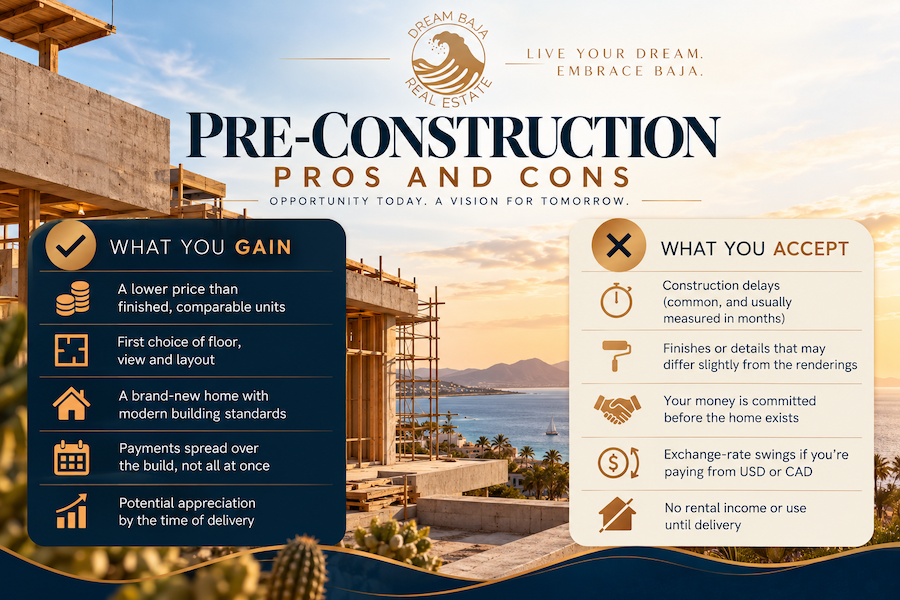
Pre-construction isn't for everyone. If you need to move in on a fixed date, if a delay would cause real financial strain, or if you'd lose sleep watching a construction schedule slip, a finished resale home may suit you better. I say that to clients regularly, and I mean it.
Did You Know? "Pre-construction" and "new construction" aren't the same thing. Pre-construction means buying before or during the build, usually on a payment schedule. New construction usually means the building is finished and you're buying a never-lived-in unit, often closing in one transaction like a resale.
The Pre-Construction Buying Process, Step by Step
Every project is a little different, but the path from "I love that rendering" to keys in your hand follows the same ten steps.
1. Get clear on why you're buying
Before you fall for a view, decide what this home is for. Full-time living, a winter escape, a rental investment, or a future retirement base all point to different projects, locations and unit types. Settle your budget too, including closing costs and a cushion for currency swings. Most foreign buyers here pay cash; some developers offer in-house payment plans, but traditional Mexican mortgages for foreigners are limited.
2. Bring your own representation
The friendly person in the sales office works for the developer. That's not a criticism, just the structure. You want a licensed broker on your side, ideally an AMPI member (the Mexican Association of Real Estate Professionals), plus an independent real estate attorney who answers only to you. In most cases the developer pays the buyer's agent commission, so representation shouldn't cost you extra. Ask to confirm that up front.
3. Shortlist the developer before the project
In pre-construction, the developer matters more than the floor plan. Ask what they've built and delivered before, then go see it. Walk a finished building, talk to owners if you can, and ask how close to schedule those projects actually finished. A developer with no completed projects isn't automatically a bad bet, but the bar for due diligence goes up.
4. Do the due diligence
This is the step that separates a good purchase from a painful one. Your attorney and broker should review the land title, permits, the developer's legal structure and the contract itself. The full checklist is in the next section.
5. Reserve your unit
Once you've chosen a unit, you'll usually sign a short reservation agreement and pay a reservation deposit. This takes the unit off the market while contracts are drafted and reviewed. Get in writing whether that deposit is refundable, for how long, and under what conditions. Practices vary from project to project.
6. Sign the purchase contract
The main agreement is typically a promissory purchase contract (a contrato de promesa de compraventa). It should spell out the unit, the price, the payment schedule, the delivery date, the finishes and specifications, what happens if construction is delayed, and what happens if the project is cancelled. Read it in English and Spanish, and have your attorney review the Spanish version, because that's the one that governs.
7. Plan how you'll hold title
If the property sits in Mexico's restricted zone (within 50 km of the coast, which covers nearly all of Baja California Sur), you'll hold it through a bank trust, known in Mexico as a fideicomiso. The bank holds title as trustee while you keep every right of ownership: use, rent, sell, improve and pass it to your heirs. Many developments already have a master trust in place, and your unit is transferred to you at closing. Ask early how title will flow to you.
8. Make your payments, by the book
Payments typically follow milestones or a calendar until delivery. Pay only by wire transfer to the account named in your contract, never in cash and never to a personal account. Keep every receipt and get a written acknowledgment from the developer for each payment. Your paper trail is your protection.
9. Follow construction and inspect at delivery
Ask for regular progress updates and visit if you can. When the unit is ready, you'll do a walkthrough and create a punch list of items to fix before you accept the keys. I strongly recommend an independent inspector at this stage. Small issues are normal in new construction; what matters is that they're documented and fixed.
10. Close before the Notario Público
The final step is formal closing before a notary (a Notario Público), a senior legal official in Mexico who verifies the transaction and registers your deed with the Public Registry of Property. You'll pay the remaining balance plus closing costs, which typically run about 4–8% of the purchase price, including the acquisition tax (ISAI, roughly 2% in Baja California Sur). In some projects, the notarized closing happens weeks or months after you receive keys, because the building's condominium regime has to be finalized first. That's normal, but it should be explained in your contract.
The Due Diligence Checklist: What to Ask the Developer For
A well-run developer will hand these over without blinking. Hesitation, vague answers or "we'll send that later" for weeks on end tells you something too.
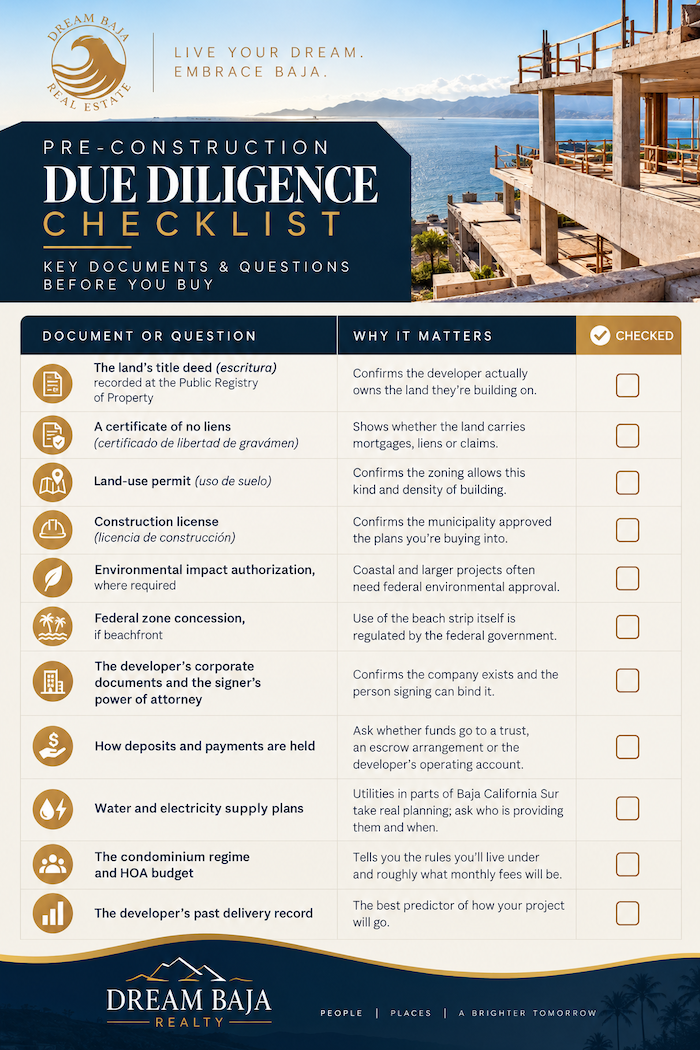
Not every document applies to every project, and your attorney may ask for more. The point is to verify, not to trust a brochure.
Did You Know? Mexico's consumer protection agency, PROFECO, has a standard (NOM-247-SE-2021) covering how developers market and sell homes, including pre-sales. Among other things, developers are expected to register their standard sales contracts with PROFECO. Asking whether a project's contract is registered is a quick, telling question. Rules evolve, so have your attorney confirm current requirements.
Payment Schedules, Currency, and Protecting Your Money
How payment schedules usually look
There's no single standard, but most projects use some version of these three approaches:
Staged payments. A down payment at signing, installments during construction, and the balance at delivery. A split like 30% / 40% / 30% is a common shape, though every developer sets its own.
Large down payment for a bigger discount. Pay most or all of the price up front and the developer typically rewards you with a lower price. Higher reward, higher exposure.
Smaller down payment, larger balance at delivery. Less money at risk during the build, usually at a higher price.
The right choice depends less on the discount and more on how much you trust this specific developer and how comfortable you are with your money tied up in an unfinished building. I generally steer first-time buyers toward schedules that keep a meaningful share of the price due at delivery. It keeps everyone's incentives pointed the same way.
Watch the currency
Most pre-construction in Baja California Sur is priced in U.S. dollars, but not all of it, and your contract should state the currency clearly. If you earn in Canadian dollars, or the price is in pesos, exchange-rate moves over an 18- to 36-month build can quietly add or subtract thousands. A currency transfer service, rather than your home bank's standard wire rate, often saves real money on each payment.
Clauses worth slowing down for
Delivery date and grace period. Most contracts allow some grace period. What happens after that? Look for a defined penalty, a credit, or a right to cancel and recover your payments.
Cancellation by the developer. If the project stalls or is cancelled, how and when is your money returned?
Your right to resell before delivery. Selling your contract to another buyer before closing is called an assignment of rights (a cesión de derechos). Many developers allow it but charge a fee or require approval. Know the terms before you sign, especially if you're buying as an investment.
Specifications annex. Finishes, appliances, square meters and parking should be written into the contract, not just shown in a brochure.
Did You Know? Mexico's anti-money-laundering rules sharply limit cash in real estate transactions. A developer, notary or seller who suggests paying part of the price in cash "to keep things simple" is a red flag, not a favor. Every peso should move by traceable bank transfer.
The Local Perspective
For many Mexican families, buying in preventa is simply how you buy a new home. It's not exotic or speculative; it's the normal way to get a better price and pick the unit you want. What locals understand, and newcomers sometimes don't, is that construction here keeps its own calendar.
In Baja California Sur, much of what goes into a building travels a long way to get here, down the length of the peninsula or across the Sea of Cortez by ferry. Summer heat slows outdoor work. Late summer and early fall bring hurricane season, and a single storm can pause a site for weeks. Permits move at the speed of the municipality. None of this means a project is in trouble. It means a realistic timeline has some breathing room built in, and a good contract accounts for it.
How I Approach Pre-Construction at Dream Baja Realty
I've represented buyers in pre-construction projects from La Paz to Los Cabos, and the pattern is consistent: the buyers who end up happiest did their homework before they fell in love with a view, not after.
When a client is considering a project, I start with the developer, not the unit. Who are they, what have they delivered, and how did those buildings hold up? Then we bring in an independent attorney to review title, permits and the contract, and we talk honestly about the payment schedule and how much risk my client is comfortable carrying. Sometimes the answer is a pre-construction unit. Sometimes it's a finished resale down the street. Both are good outcomes if they fit.
[Insert Ian's experience guiding a client through a specific pre-construction purchase, from reservation to delivery.]
As an AMPI board member here in La Paz, I also see what happens when buyers skip representation entirely. Most of those stories are avoidable, and that's really the point of this article.
Practical Tips Before You Sign
Visit in person at least once. Stand on the lot at the hour you'd use the terrace. Notice the wind, the afternoon sun, the neighbors' roofline, the road noise. Renderings never show the panga engines at 6 AM or the bakery smell drifting from the corner.
Ask what's built around you next. That empty lot facing your future view may have its own permits.
Budget for the extras. Closing costs, fideicomiso setup and annual fees, furniture, window coverings, and appliances if they're not included all arrive at delivery.
Plan your exit before your entry. If you might sell before delivery, read the assignment terms now.
Keep a single folder. Contract, annexes, every payment receipt, every developer email. You'll want it at closing.
Don't let a deadline rush you. "Prices go up Friday" is a real thing in phased sales. So is losing far more than one price increase to a bad contract.
Your Next Steps
Write down your goal, budget and the earliest date you actually need the home.
Talk to a licensed, AMPI-affiliated buyer's agent who works the area you're considering.
Shortlist two or three developers and visit something each has already finished.
Engage an independent real estate attorney before you pay anything beyond a refundable reservation.
Review the contract, the payment schedule and the delivery terms line by line, in Spanish.
Set up a currency transfer account so your first payment isn't your most expensive one.
Frequently Asked Questions
Can foreigners buy pre-construction property in Mexico? Yes. Americans, Canadians and other foreigners buy pre-construction regularly. In the coastal restricted zone, which covers almost all of Baja California Sur, you'll hold title through a fideicomiso, a bank trust that gives you full ownership rights.
How much cheaper is pre-construction than a finished unit? It varies by project, phase and market. Early-phase pricing is usually lower than the price of the same unit at completion, which is the main reason people buy early. Be wary of anyone promising a specific appreciation number.
What happens if construction is delayed? Delays are common and are usually covered by a grace period in the contract. Beyond that, your protection depends on what the contract says, such as penalties, credits or a right to cancel. That's why the delay clause deserves careful review.
What if the developer never finishes? It's the biggest risk in pre-construction, and the best defense is choosing a developer with a delivery track record and reviewing how your payments are held. Your contract should state how funds are returned if the project is cancelled.
Do I need my own real estate agent if I'm buying from a developer? I'd strongly recommend it. The developer's sales team represents the developer. In most cases the developer pays the buyer's agent commission, so having someone on your side typically doesn't add to your cost.
Do I need a lawyer as well? Yes. The Notario Público handles closing and registration, but doesn't represent you during the contract stage. An independent real estate attorney reviews title, permits and the contract on your behalf.
Can I sell my unit before it's finished? Often, yes, through an assignment of rights (cesión de derechos). Most developers set conditions, such as a fee or a minimum percentage paid. Check these terms before signing if resale is part of your plan.
Can I get a mortgage for pre-construction in Mexico? Most foreign buyers pay cash. Some developers offer in-house payment plans stretched over the build, and a few lenders work with foreign buyers, but financing options are limited. It's worth asking each developer directly.
When do I pay closing costs? At the final closing before the notary, usually at or after delivery. Plan on roughly 4–8% of the purchase price, though your notary will give you the exact figure.
Is pre-construction a good investment? It can be, especially in early phases with a strong developer. It also ties up your money with no income until delivery. I'd treat it as a solid option to weigh carefully, not a guaranteed win.
Want the Whole Process in One Place?
Pre-construction is one chapter of a bigger story. My buyer's guide, How to Buy Your Dream Home in Baja, walks through the full purchase process, from the fideicomiso and closing costs to the key players you'll meet along the way. It's free, and it's the same guide I hand my own clients before we start looking.
Download the buyer's guide at dreambajarealty.com