DREAM BAJA REALTY SELLER GUIDE
Selling Property in Mexico: A Guide for Property Owners in La Paz and Baja California Sur
Selling property in Mexico is entirely manageable, but the process works differently from a typical sale in the United States or Canada. The professionals involved, the closing documents, the way ownership is transferred and the handling of funds all follow Mexican procedures.
Before listing, it is important to understand how the property is titled, whether the documentation is complete, how taxes and currency may affect your proceeds, and what qualified closing professionals will require. A realistic view of the property’s current market value—and a clear picture of the likely net proceeds—creates the foundation for a smoother sale.
Licenced Baja California Sur brokerage
LIC-RAPIBCS-0850
AMPI La Paz

Full BCS MLS access

Based in La Paz
Baja California Sur market experts
Experience selling foreigh-owned property
100's of successful transactions
How Does Selling Property in Mexico Work?
Selling property in Mexico normally begins by confirming how the property is owned and whether the documentation is ready for a sale. The next steps are estimating its current market value and the seller’s probable net proceeds, preparing and marketing the property, negotiating an offer, and completing buyer and notarial due diligence.
Before closing, the seller’s taxes and transaction expenses are calculated. The required documents are then signed, title or trust rights are transferred, the purchase funds are released according to the transaction agreement, and possession is delivered to the buyer.
The exact process depends on the property’s ownership structure, documentation, location, the seller’s residency and tax circumstances, and the terms negotiated with the buyer.
THE SELLING PROCESS: A QUICK OVERVIEW
1.
Confirm ownership and documentation
Review the title deed, bank-trust documents or other ownership records and identify anything that may need to be updated, corrected or completed.
2.
Estimate market value and probably proceeds
Evaluate the property against current competition and available market evidence, then prepare a preliminary estimate of the expenses that may affect the seller’s net proceeds.
3.
Prepare and market the property
Address presentation, maintenance, photography, included furnishings, showing access and the marketing strategy needed to reach the appropriate buyers.
4.
Evaluate and negotiate an offer
Review the price together with the deposit, contingencies, included property, proposed closing date, possession terms and allocation of transaction expenses.
5.
Complete due diligence
The buyer and the professionals handling the transaction review the property, ownership records and supporting documents to confirm that the agreed transfer can proceed.
6.
Confirm taxes and closing expenses
Qualified tax, legal and closing professionals calculate the seller’s transaction-specific obligations and identify the funds and documents required for closing.
7.
Complete the transfer and deliver possession
Once the agreed conditions are satisfied, the parties complete the required signing and funding process. Title or bank-trust rights are transferred, the seller receives the funds according to the transaction agreement, and keys and possession are delivered to the buyer.
A smoother sale begins before the listing goes live. Finding a missing or inconsistent document during preparation gives the seller time to address it. Finding it after a buyer, deposit and closing deadline are involved can delay—or jeopardize—the transaction.
"Complicated transaction? No Problem!"

"Ian from Dream Baja Realty is a great real estate agent and I highly recommend his services! I had 3 properties which had some tax issues that needed to be taken care of and Ian was instrumental in getting everything done in a timely manner… Going into this, I knew I needed an agent with deep experience to handle my case with 3 transactions simultaneously…Ian came through and was the key to my successful closings!”
- Alan Morimoto
The Questions Most Sellers Ask First
Every property and transaction is different, but most sellers begin with the same practical questions. These short answers provide a useful starting point before we look at your property and circumstances in detail.
Can a Foreign Owner Sell Property in Mexico?
Yes. Foreign owners can sell their property rights in Mexico. The required process depends on how the property is owned, the condition of the ownership documents and the structure of the proposed transaction.
Do I Have to Be in Mexico to Sell?
Not always. Some sellers can complete the transaction through properly prepared legal authority. The requirements vary, so the closing professionals should confirm what is needed before you assume the sale can be completed remotely.
Who Calculates the Seller's Taxes?
The qualified tax and closing professionals handling the transaction calculate the seller’s tax obligations. A broker, online calculator or general percentage cannot provide a reliable seller-specific result.
What Happens if the Property Is Held in a Fideicomiso?
The existing bank trust becomes part of the closing review. The trustee’s requirements, the condition of the trust documents and the buyer’s proposed ownership structure help determine how the property rights will be transferred.
How Is the Property's Market Value Determined?
Market value is estimated by reviewing available market evidence, current competing properties, location, condition, documentation, included furnishings and the buyers active in that price range. It is not determined by the seller’s investment or a neighbor’s asking price alone.
What Should I Do Before Listing?
Start with a preliminary review of the property, ownership structure, documents and likely market position. Identifying pricing or documentation issues before marketing begins gives you more time and more control over how they are addressed.
Selling Property in La Paz and Baja California Sur
La Paz is not one uniform real estate market. A walkable condo near the malecón, a hillside home overlooking the bay, a larger property in El Centenario and a beachfront house outside the city attract different buyers for different reasons.
Pricing and presentation must begin with how the property fits into its specific part of the market. Neighborhood, access, views, services, construction quality, condition and documentation can matter as much as the number of bedrooms or the size of the lot.
Season also influences the experience of selling. Winter brings more seasonal visitors to Baja California Sur, but serious buyers do not disappear with the summer heat. The more important questions are whether the property is priced realistically, presented well, easy to show and ready to withstand scrutiny when an interested buyer begins asking questions.
Properties near the water have their own practical realities. Salt, sun, humidity and periods without occupancy can leave a visible record. Air-conditioning systems, pumps, pools, roofs, exterior finishes, landscaping and signs of moisture should be reviewed before photography and showings begin—not explained away after a buyer notices them.
A beautiful view may bring someone through the door. It will not compensate for unclear ownership, incomplete construction records, difficult access or a price that ignores the buyer’s alternatives.
The Local Pricing Conversation
Sellers often begin with a number based on what they need from the sale, what they invested in the property or what a neighbor is asking. Buyers begin somewhere else: they compare the property with everything else available to them today.
Our role is to bring those two realities into the same conversation. That means looking at the available evidence, recognizing what makes the property distinctive and being honest about anything that may reduce demand or narrow the potential buyer pool.
The goal is not simply to place the highest possible asking price on the property. It is to position the property where qualified buyers will take it seriously—and where the seller can evaluate real offers with a clear understanding of the market.
A local perspective
In La Paz, sellers often hear what a neighbor is asking and assume that number establishes the value of their own property. It doesn’t. An asking price tells us what an owner hopes to receive; it does not tell us what a buyer has agreed to pay.
Buyers compare neighborhoods, condition, views, access, documentation and current alternatives—often across several parts of Baja California Sur. The most effective pricing strategy respects what makes a property special while remaining grounded in what buyers can choose instead.
What Is My Property in Mexico Worth?
A useful pricing analysis is not a flattering number, and it is not a promise. It is an informed estimate of where a property fits in the current market and how buyers are likely to compare it with their other options.
The price a seller paid, the money invested in improvements and the amount needed from the sale are all relevant to the owner. They do not, however, determine what the market will pay today. Market value comes from the relationship between the property, the available competition and the buyers currently searching within that price range.
When evaluating a property, we consider:
Recent sales and other available market evidence
Current competing listings
Neighborhood and micro-location
Property type, lot size and usable living space
Views and the possibility of future view obstruction
Access, parking, utilities and nearby services
Construction quality, age and condition
Title and documentation readiness
Furniture, appliances and other items included in the sale
Rental history when it is documented and relevant
The seller’s desired timing and ongoing carrying costs
Currency and price-presentation strategy
The size of the likely buyer pool at the proposed price

Some properties are easy to compare. Others are genuinely unusual. A custom hillside home, a beachfront lot or a residence with extensive additions may require more judgment than a condo in a development with several recent sales.
The purpose of the analysis is not to force every property into a formula. It is to identify the price range in which its strengths will matter, and where its limitations will not be ignored.
Why Online Estimates Are Less Reliable in Baja
Automated estimates work best in markets with standardized homes and deep, consistent public sales records. Baja California Sur is different.
Two properties that look similar online may have very different construction quality, access, water systems, utilities, maintenance histories, furnishings, views and documentation. Even homes within the same neighborhood can appeal to different buyers because of elevation, road conditions, orientation or proximity to services.
An online estimate can be a starting point. It is not a substitute for seeing the property, reviewing the available documents and understanding what buyers are comparing it with right now.
Start With a Confidential Property Review
You do not need to be ready to list. We can begin with the property, your goals, the ownership structure and any questions you already know are waiting in the file.
The first conversation is designed to help you understand the property’s likely market position, what information is still needed and which next step would be most useful.
Documents Sellers Should Gather Before Listing
Every property file is different, but gathering the common starting documents early gives the seller, brokerage and closing professionals a clearer picture of what is ready—and what may need attention before a buyer becomes involved.
The goal is not to assemble a perfect closing file by yourself. It is to identify the documents already available, locate anything that may be missing and give the appropriate professionals enough information to provide a property-specific list.
Depending on the property and ownership structure, the initial review may include:
The current title deed or bank-trust documents
Seller identification and civil-status documents, as applicable
Property-tax receipts
Water, electricity and other property-account information
Condominium or homeowners-association documents and account balances
Construction permits, plans, completion records or regularization documents
Surveys, measurements, boundaries or lot records, where applicable
Existing leases or property-management agreements
An inventory of furniture, appliances and other items included or excluded
Documents from the seller’s original purchase
Records supporting documented construction or improvements
Powers of attorney, estate documents or inheritance records, when relevant
Corporate documents if the property is held through a Mexican company
Fideicomiso statements, trustee correspondence and beneficiary information, when applicable
Not every seller will need every item on this list. The final requirements depend on the property, municipality, ownership structure and transaction. The qualified legal, tax and closing professionals should provide the definitive checklist for the specific sale.
What if I Am Missing a Document?
A missing document does not automatically mean the property cannot be sold. It does mean the issue should be identified early enough to understand what must be obtained, corrected or regularized—and how that work may affect the listing strategy and timeline.
If the physical property no longer matches the documents because of an addition, subdivision, remodeled area or boundary question, raise it during the initial review. It is better to understand the discrepancy before marketing begins than after a buyer has made an offer.
Did You Know?
A property can look completely ready for the market while its paperwork tells a different story. Reviewing the file before accepting an offer gives the seller time to address questions without a buyer’s deposit and closing deadline attached.
What Happens When the Property Is Held in a Fideicomiso?
Many foreign owners in coastal Baja California Sur hold their property rights through a bank trust, known in Mexico as a fideicomiso. When the property is sold, the trust becomes part of the transaction rather than something handled separately afterward.
The Mexican bank acts as trustee, while the foreign owner is the beneficiary of the trust. The beneficiary generally holds the rights to use, improve, rent, sell and pass those beneficial rights to designated beneficiaries, subject to the trust documents and Mexican law.
Before listing, the seller’s trust documents should be reviewed together with the property records. The initial review may consider:
The name of the trustee bank
The current beneficiary or beneficiaries
The remaining term of the trust
Whether annual trustee fees and other obligations are current
Whether substitute beneficiaries are correctly recorded
Whether the trust description matches the property being sold
Whether any amendments, assignments or prior changes appear in the file
The trustee bank’s current requirements and processing times
Depending on the existing trust, the buyer’s proposed ownership structure and the advice of the closing professionals, the transaction may involve assigning the existing beneficial rights, establishing a new trust, cancelling or replacing the existing structure, or using another approved method.
There is no single procedure that applies to every fideicomiso sale. The trustee bank, trust documents, permits, buyer requirements and condition of the property file can all affect the route taken.
The useful question is not simply, “Can the fideicomiso be transferred?” It is:
“What is the cleanest approved way to transfer this property to this buyer, and what does the seller need to prepare?”
Reviewing the trust early can help identify unpaid fees, outdated beneficiary information, document inconsistencies or bank requirements before they become closing delays.
Dream Baja Realty can help coordinate the real estate side of the transaction, but the trustee bank and qualified legal, tax and closing professionals must confirm the appropriate structure, required documents, fees and timing for the specific sale.
Capital Gains Tax and ISR When Selling Property in Mexico
Mexico’s income tax is commonly referred to as ISR. For many property owners, it is the largest unknown in the selling process - and one of the worst areas in which to rely on a casual estimate, an online calculator or another seller’s experience.
The amount, if any, depends on the specific transaction and the seller’s circumstances. The calculation may consider factors such as:
The ownership structure
The seller’s tax position
The property’s recorded acquisition value
The proposed transaction value
The dates and exchange rates relevant to the calculation
Properly documented construction, improvements and eligible expenses
The supporting invoices and records accepted for the transaction
The number and circumstances of the owners
Any exemption for which a seller may qualify
The difference between the price originally paid and the new sale price is not, by itself, a reliable do-it-yourself tax calculation. The values formally recorded in the ownership and acquisition documents may matter, as can the quality of the records supporting improvements and other eligible expenses.
Can a Seller Qualify for an ISR Exemption?
An exemption may be available in some circumstances, but eligibility should never be assumed or promised during a listing conversation.
The rules, evidence and seller circumstances must be reviewed by the qualified professional responsible for the transaction. A result obtained by a neighbor, friend or previous seller does not establish what will apply to a different owner or property.
If an exemption may be relevant, raise the question early. Waiting until a closing date has been negotiated can leave the seller making important decisions without a reliable understanding of the probable net proceeds.
Why Documentation Matters
Invoices, acquisition records and documents supporting qualifying construction or improvements may affect the calculation when they satisfy the applicable requirements. Receipts, informal estimates and undocumented spending should not automatically be assumed to receive the same treatment.
Gather the available records and let the qualified professional determine what can properly be considered.
Request a Preliminary Estimate Before Accepting an Offer
Before setting firm expectations about net proceeds, request a transaction-specific estimate from the appropriate tax or closing professional.
That estimate should be based on the proposed sale, the seller’s circumstances and the actual documents—not a generic percentage. If the price, exchange rate, transaction structure or supporting documentation changes, the estimate may change as well.
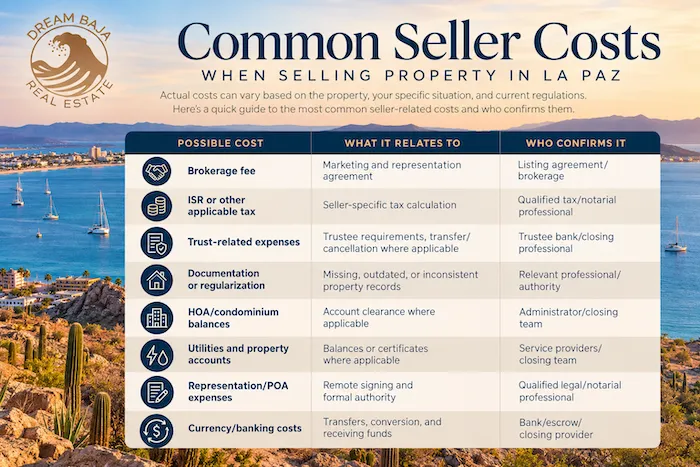
What Costs Does a Seller Pay in Mexico?
The costs of selling property in Mexico vary from one transaction to another. Your ownership structure, tax position, property documentation, listing agreement, and negotiated sale terms can all affect the final amount.
Before accepting an offer, ask for a preliminary estimate of your likely selling expenses and net proceeds. The estimate may change as the notary and other closing professionals review the transaction, but it gives you a more realistic basis for evaluating offers.
Real Estate Brokerage Fees
The seller normally pays the real estate commission agreed upon in the listing agreement. Confirm what services are included, whether IVA applies to the fee, when the commission becomes payable, and how cooperating brokers will be compensated.
A professional listing service should include more than placing the property online. It may include pricing guidance, photography, listing preparation, marketing, buyer qualification, showing coordination, offer negotiation, document collection, and support through closing.
Income Tax on the Sale
The seller may be responsible for Mexican income tax, commonly referred to as ISR, on the taxable gain from the sale.
The calculation is not necessarily based on the difference between the original purchase price and the current sale price alone. The notary or tax professional may also consider the value recorded in the deed, documented improvements, eligible deductions, ownership history, inflation adjustments, residency status, and whether an exemption may apply.
Because the calculation is specific to the seller and property, obtain an estimate from the notary or a qualified Mexican tax professional before relying on a projected net figure.
Fideicomiso or Trust-Related Expenses
If the property is held through a fideicomiso, the transaction may involve trustee review, bank documentation, trust-assignment or cancellation procedures, outstanding annual trust fees, and other bank charges.
The applicable expenses depend on whether the buyer will assume the existing trust rights, establish a new fideicomiso, or acquire the property through another permitted ownership structure. The trustee bank and notary should confirm the process and costs for the specific transaction.
Documentation and Property Regularization
Unresolved property issues can create additional expenses before closing. These may include obtaining missing records, correcting names or measurements, updating registrations, formalizing improvements, resolving title inconsistencies, or completing estate and succession procedures.
These costs are highly property-specific. Identifying them before listing can reduce delays and prevent unexpected deductions from the seller’s proceeds.
HOA and Condominium Balances
If the property belongs to a condominium or homeowners association, the seller may need to provide proof that all assessments are current.
Outstanding dues, special assessments, transfer charges, or administrative fees may need to be paid before the association issues the clearance documents required for closing. Ask the administrator for a current account statement early in the process.
Property Tax, Utilities, and Other Outstanding Accounts
Property taxes, water charges, utilities, and other property-related accounts generally need to be current before title or trust rights can transfer.
Any unpaid balances, penalties, or costs required to obtain clearance certificates may be deducted from the seller’s proceeds or paid before closing. Keep receipts and account records available so these items can be verified efficiently.
Powers of Attorney and Remote-Signing Costs
A seller who cannot attend closing in person may need a properly prepared and legalized power of attorney. Depending on where it is signed, the document may require notarization, an apostille or legalization, certified translation, and formal registration or acceptance in Mexico.
Have the notary approve the form and wording before signing it. A document that is acceptable in the seller’s home country may not automatically satisfy the requirements for a Mexican real estate transaction.
Banking, Currency, and Funds-Transfer Costs
International transactions can include escrow fees, bank charges, wire-transfer costs, currency-conversion expenses, and fees associated with receiving or distributing funds.
The purchase agreement should clearly identify the transaction currency, how the exchange rate will be determined if conversion is required, where the funds will be held, and who is responsible for each charge.
Seller Planning Tip
Ask for a preliminary seller net sheet before listing and request an updated version before accepting an offer. It should show the estimated sale price, brokerage fees, estimated taxes, trust or title expenses, outstanding property accounts, closing-related charges, and the seller’s projected net proceeds.
A net sheet is an estimate, not a guarantee. Final figures can change after the notary, trustee bank, tax professional, association, and other closing participants complete their reviews.
The Step-by-Step Process for Selling Property in Mexico
Every sale is a little different, but a well-managed transaction generally follows the same path. The objective is to identify potential problems early, present the property properly, negotiate clear terms, and keep the closing file moving from the accepted offer through possession.
1. Initial Consultation
The process begins with a conversation about your property, goals, preferred timing, and reason for selling. We will also discuss how the property is owned, whether it is occupied or rented, whether you plan to be in Mexico during the sale, and any concerns you already have about the title, fideicomiso, taxes, condition, or closing process.
This initial review helps establish a practical strategy for the sale rather than treating every property the same way.
2. Document Review
Before the property is actively marketed, the available ownership and property records should be reviewed. This may include the deed or fideicomiso, property-tax receipts, trust statements, identification documents, utility records, condominium information, construction documents, and records for additions or improvements.
The purpose is not to complete the notary’s formal due diligence in advance. It is to identify obvious missing, outdated, or inconsistent records before they become an obstacle during a transaction.
3. Pricing Analysis
The asking price should be based on current competition, recent market evidence where available, the property’s condition, location, features, documentation, and likely buyer profile. A seller may choose any asking price, but the market ultimately determines whether buyers consider the property competitive. Pricing too far above comparable alternatives can reduce showings, extend the listing period, and make later price reductions less effective.
The goal is to position the property so that qualified buyers understand its value from the beginning.
4. Property Preparation
Before photography and showings begin, the property should be prepared for the market. This may involve cleaning, decluttering, completing practical repairs, improving lighting, refreshing landscaping, organizing storage areas, and removing personal or valuable items. Furnished properties should also have a clear preliminary inventory of what is included and excluded.
Not every property needs a major renovation. Often, the most useful improvements are the ones that make the home easier to understand, inspect, photograph, and imagine living in.
5. Listing Launch and Distribution
Once the price, documentation, presentation, and listing agreement are in place, the property can be introduced to the market.
The listing should clearly describe the property, location, ownership structure, important features, inclusions, and any material limitations buyers need to understand. Professional images and accurate information should work together to set reasonable expectations before a showing is scheduled.
Distribution may include the appropriate MLS, brokerage networks, property-search websites, direct buyer outreach, and other marketing channels suited to the property.
6. Showings and Buyer Feedback
A showing plan should balance buyer access with the seller’s privacy, security, and schedule. If the property is occupied, rented, or used as a vacation home, advance-notice requirements and access instructions should be established before the listing goes live. Keys, alarm systems, pets, staff, and tenant communication should also be addressed.
Feedback from qualified buyers and cooperating agents can help identify recurring concerns about price, condition, presentation, or market positioning.
7. Offer Review and Negotiation
An offer should be evaluated as a complete set of terms—not only by its headline price. Important considerations may include the deposit, payment schedule, financing or sale contingencies, due-diligence period, requested furnishings, closing date, possession date, currency, exchange-rate language, and responsibility for particular expenses.
The strongest offer is often the one that provides the best combination of price, clarity, buyer readiness, and likelihood of closing.
8. Due Diligence and Closing File
After an offer is accepted, the buyer and the professionals involved in the transaction begin or continue their formal review. The closing file may involve the notary, escrow provider, trustee bank, tax professional, closing coordinator, condominium administrator, government offices, and other specialists depending on the property.
Requests for additional documents or corrections are normal. Responding promptly and keeping all parties informed can help prevent avoidable delays.
9. Tax and Net-Proceeds Estimate
As the file develops, the seller should receive a transaction-specific estimate of taxes, closing expenses, and projected net proceeds. This estimate should reflect the actual offer, ownership structure, available deductions, trust requirements, outstanding property accounts, and other known expenses. It may be revised as the notary and closing professionals complete their calculations.
Review the estimate carefully and ask questions before the closing date. The amount a property sells for and the amount the seller receives are not the same figure.
10. Closing and Delivery of Possession
At closing, the required documents are signed, funds are distributed according to the transaction instructions, and title or fideicomiso rights are transferred to the buyer. Possession should be delivered according to the purchase agreement. This may include handing over keys, remotes, access codes, inventories, appliance information, utility records, and instructions for community or building access.
The condition of the property, included furnishings, and possession date should be confirmed before closing so both parties understand what will be delivered.
How Long Does It Take to Sell and Close?
There is no reliable universal timeline. The marketing period depends on price, property type, location, condition, demand, and access for showings. Once an offer is accepted, closing time can be affected by the ownership structure, document condition, buyer requirements, trustee-bank procedures, tax calculations, and government or notarial processing.
A realistic schedule should be established for the individual property and updated as the transaction progresses.
How Dream Baja Realty Prepares and Markets a Listing
Effective real estate marketing is not simply a matter of putting a property online. It begins with the right price, complete information, strong presentation, reliable showing access, and a clear understanding of the buyers most likely to value the property.
At Dream Baja Realty, we build the listing strategy around the individual property. A waterfront condominium, a family home in La Paz, a development parcel, and an off-grid residence should not be presented to the market in exactly the same way.
Pricing and Market Positioning
We begin by reviewing the property’s location, condition, features, ownership structure, documentation, and competition.
The purpose is to identify how the property fits within the current market and how buyers are likely to compare it with available alternatives. Where useful market evidence is available, we consider it alongside active competing listings and the characteristics that make the property more - or less - attractive to its likely buyer.
The final asking price is the seller’s decision. Our role is to provide candid guidance so that decision is informed by the market rather than based only on an online estimate, an old valuation, or the price of a property that is not truly comparable.
Listing Preparation
Before launching the property, we help identify the information and preparation needed to present it clearly.
This may include recommending practical repairs, cleaning, decluttering, landscaping, staging adjustments, or improved access for photography and showings. We also organize the property details buyers commonly want to know, such as the ownership structure, included furnishings, community fees, utilities, construction history, and notable features.
Preparing this information early gives buyers a clearer picture of what is being offered and reduces confusion later in the process.
Photography and Visual Presentation
Strong visual presentation helps buyers understand the property before deciding whether to schedule a showing.
The photography should accurately represent the home, land, views, setting, and condition. When appropriate for the property and marketing plan, additional visual materials may be used to provide more context.
The goal is not to make the property appear to be something it is not. It is to show the property at its best while keeping the presentation accurate enough that buyers arrive with realistic expectations.
Clear Property Description
A good listing description should do more than repeat the number of bedrooms and bathrooms.
We explain how the property lives, what distinguishes its location, which features matter most, and what a buyer should understand about the offering. We also work to keep the factual details consistent across the listing materials so buyers and cooperating agents are not receiving conflicting information.
Where appropriate, the property can be presented for an international audience with clear language that helps buyers from the United States, Canada, Mexico, and elsewhere understand the ownership and purchasing context.
MLS and Brokerage Exposure
Qualified buyer leads often come through other real estate professionals. For that reason, cooperating-agent exposure is an important part of the marketing strategy.
When suitable and available for the listing, the property may be entered into the applicable multiple listing service and shared through professional brokerage networks. This allows participating agents to find the property, review its details, and present it to buyers whose criteria may be a good match.
We also make the information needed for showings and inquiries available to cooperating professionals, subject to the seller’s privacy and security requirements.
Online and Direct Marketing
Depending on the property, its audience, and the selected marketing plan, exposure may include Dream Baja Realty’s website, property-search channels, direct buyer communication, email, social media, video, editorial content, and other appropriate digital outlets.
Not every marketing channel is equally useful for every listing. We focus on the places and formats most likely to reach suitable buyers instead of assuming that more exposure automatically produces a better result.
Marketing may also evolve as buyer response becomes clearer. Inquiry quality, showing activity, recurring objections, competing inventory, and changes in the market can all inform later adjustments.
Showing Coordination and Feedback
Once the listing is active, we coordinate showing requests according to the access plan established with the seller.
We provide buyers and cooperating agents with the information needed to evaluate the property while protecting the seller’s privacy and security. When useful feedback is received, we share it with the seller and look for patterns rather than overreacting to one person’s opinion.
Repeated feedback about price, condition, access, presentation, or documentation may indicate that part of the strategy needs to be adjusted.
Offer Comparison and Negotiation
When an offer is received, we help the seller evaluate the full proposal.
This includes not only the price, but also the deposit, payment method, contingencies, due-diligence period, requested inclusions, closing schedule, possession terms, and the buyer’s apparent readiness to proceed.
If multiple offers or revisions are involved, we help organize the terms so the seller can compare them clearly and make an informed decision.
Transaction Coordination Through Closing
Marketing does not end when an offer is accepted.
We remain involved as the transaction moves through document collection, due diligence, inspections, escrow, notarial review, tax estimates, trustee-bank requirements where applicable, closing, and delivery of possession.
Legal, tax, escrow, and notarial decisions remain within the responsibilities of the qualified professionals handling those parts of the transaction. Our role is to help the seller understand what is happening, keep communication moving, and coordinate the practical real estate details from listing through closing.
More exposure cannot correct an unrealistic price, unresolved documentation, poor presentation, or a property that is consistently difficult to show.
The strongest listing campaigns begin with the fundamentals: clear paperwork, honest positioning, dependable access, accurate information, and a property prepared for the buyers it is meant to attract. Marketing works best when all of those pieces support one another.

How to Prepare a Baja Property for Sale
Preparing a property for sale does not always require a major renovation. The goal is to remove avoidable distractions, make the home easy to understand, and give buyers confidence that the property has been cared for.
In Baja California Sur, sun, salt air, dust, seasonal weather, and long periods without occupancy can leave visible signs more quickly than many owners expect. A practical round of maintenance and presentation work can make a meaningful difference before photography and showings begin.
Take Care of Active Maintenance Issues
Start with problems a buyer will notice immediately or that could worsen while the property is being marketed.
Check for active leaks, plumbing problems, air-conditioning issues, faulty pumps, electrical concerns, broken fixtures, damaged screens, loose hardware, and visibly deferred maintenance. If the property has a pool, water-storage system, pressure system, solar equipment, generator, or other specialized systems, confirm that they are operating as represented.
You do not need to make an older property look new. It is better to address important defects and be honest about the remaining condition than to rely on cosmetic improvements that hide a larger problem.
Address Moisture, Odors, and Salt Corrosion
A closed home can quickly develop stale air, drain odors, moisture marks, or signs of corrosion.
Air out the property before showings, clean drains and air-conditioning filters, and investigate persistent odors rather than covering them with strong fragrances. Inspect exterior hardware, railings, light fixtures, doors, windows, appliances, and mechanical equipment for visible salt or weather damage.
These details may seem minor to an owner who sees the property regularly, but they can shape a buyer’s impression of how the home has been maintained.
Improve the Exterior and Landscaping
The buyer’s first physical impression begins before the front door opens.
Trim overgrown landscaping, remove dead plants and debris, clean patios and terraces, repair obvious irrigation problems, and make sure paths and entrances are easy to use. Pools and water features should be clean and operating properly whenever possible.
For condominiums, the seller may not control the common areas, but the private entrance, terrace, windows, doors, and any seller-maintained exterior spaces should still be presented carefully.
Clean and Remove Excess Personal Items
A thorough cleaning is one of the simplest ways to improve a property’s presentation.
Remove unnecessary personal belongings, crowded decorations, excess furniture, old supplies, and items that make rooms or storage areas difficult to see. Buyers should be able to understand the available space without feeling that they are walking through someone else’s unfinished move.
Secure or remove passports, financial records, medications, jewelry, cash, spare keys, and other private or valuable items before showings begin.
Create an Accurate Inventory
If furniture, appliances, artwork, equipment, vehicles, or other personal property may be included in the sale, prepare a written inventory.
Clearly identify what is included, what is excluded, and which items may be negotiable. Avoid vague descriptions such as “fully furnished” unless every party understands exactly what that means.
An accurate inventory can prevent disagreements during negotiation, the final walk-through, and delivery of possession. Update it if anything is removed, replaced, or added while the property is listed.
Make Access Dependable
A property that is consistently difficult to show can lose qualified buyers.
Establish a reliable access plan before the listing goes live. Confirm who controls the keys, how much notice is required, whether tenants or guests are involved, and what instructions apply to gates, alarms, pets, staff, or community security.
If you will be away, appoint a dependable local contact who can help with access, urgent maintenance, weather preparation, and practical issues that may arise during the listing period.
Gather Utility and Service Information
Buyers commonly ask how the property operates and what ongoing ownership may involve.
Gather recent information for electricity, water, gas, internet, homeowners or condominium fees, pool service, landscaping, property management, insurance, security, and other recurring services.
If the property uses solar power, water storage, septic systems, propane, generators, or specialized equipment, prepare a simple explanation of how those systems work and who services them. Keep account numbers and sensitive personal information private until they are legitimately required.
Plan Photography Around the Property
Photography should present the property attractively and honestly.
Whenever practical, schedule images when the home is clean, the exterior is prepared, and the natural light supports the property’s best features. Views should be shown accurately, and images should not imply that a room, lot, access point, or surrounding area is different from what a buyer will experience in person.
If seasonal weather, nearby construction, access conditions, or another visible factor materially affects the property, discuss how it should be handled before marketing begins.
Be Careful With Major Renovations
Some repairs are necessary to protect the property or remove a clear obstacle to a sale. A major renovation, however, does not automatically return its full cost.
Before replacing a kitchen, remodeling bathrooms, installing expensive finishes, or making other substantial improvements, consider the likely buyer, competing inventory, expected sale price, project timing, and whether the work can be properly documented.
In some cases, a sensible repair and realistic price will serve the seller better than an expensive project based on personal taste.
Did You Know?
A buyer’s first impression often begins online, but the closing file can matter just as much as the photographs.
Clean rooms and attractive images may generate interest. Clear ownership records, documented improvements, current property accounts, and an organized file help that interest move toward a successful closing. The strongest preparation plan addresses both.
Evaluating an Offer: Price Is Only One Term
The highest offer is not always the strongest offer.
A purchase proposal should be reviewed as a complete package. Price matters, but so do the buyer’s deposit, contingencies, payment terms, closing schedule, requested inclusions, and ability to complete the transaction.
Before accepting or countering an offer, make sure you understand what the buyer is promising, what conditions must be satisfied, and what could allow either party to cancel.
Purchase Price and Estimated Net Proceeds
Begin with the offered price, then consider what you are likely to receive after the estimated costs of the sale.
Two offers at the same price can produce different results if they allocate expenses differently or include different requests for repairs, furniture, credits, or concessions.
Ask for an updated preliminary seller net sheet when evaluating a serious offer. Tax and closing figures may still change as the file is reviewed, but the estimate provides a more useful comparison than the purchase price alone.
Deposit and Escrow Terms
Review how much the buyer will deposit, when the deposit is due, where it will be held, and under what conditions it may be returned or released.
The offer should identify the proposed escrow provider or holding arrangement and explain what happens to the deposit if the transaction closes, a contingency is not satisfied, or one party fails to perform.
A large deposit does not automatically make an offer safe. The language governing that deposit matters just as much as the amount.
Due-Diligence Conditions
Buyers commonly need time to review the property and transaction before proceeding unconditionally.
The offer should define the scope and timing of any due diligence, which may include title or trust review, document review, inspections, surveys, permits, condominium records, utility information, or other property-specific matters.
Pay attention to how long the review period lasts, what information the seller must provide, and what rights the buyer has if the results are unsatisfactory.
Furniture and Personal Property
If furniture, appliances, artwork, vehicles, equipment, or other personal property are part of the negotiation, the agreement should identify them clearly.
Use a written inventory to show what is included, excluded, or separately negotiable. Avoid relying on verbal statements or broad descriptions such as “turnkey” or “fully furnished.”
The parties should also understand the expected condition of included items and whether any items will be removed before possession is delivered.
Currency and Payment Terms
An offer should state the purchase price currency and explain how payments will be made.
If the price, deposit, closing funds, or seller proceeds involve more than one currency, the agreement should address how any required conversion will be calculated. Even a modest exchange-rate movement can affect the final amount received.
Confirm the proposed escrow, banking, and payment arrangements with the appropriate closing professionals before assuming they will work as intended.
Closing Timeline
Review the proposed closing date in the context of the actual property and ownership structure.
A buyer’s preferred date may not allow enough time for document corrections, notarial review, trustee-bank procedures, tax calculations, financing, government processing, or remote-signing requirements.
The agreement should establish a realistic target and explain how extensions or delays will be handled. Avoid accepting an aggressive deadline merely because it makes an offer appear stronger.
Possession Date
Closing and possession do not always have to occur at exactly the same moment, but the agreement should state clearly when the buyer will receive the property.
If the seller, a tenant, or a vacation guest will remain temporarily, the arrangement should address access, utilities, security deposits where appropriate, property condition, and responsibility for damage or ongoing expenses.
Keys, remotes, access codes, inventories, and community-entry information should be organized before possession is delivered.
Inspection and Condition Requests
An offer may allow the buyer to inspect the property and request repairs, a price adjustment, a credit, or cancellation based on the findings.
The agreement should specify the inspection period and the process for raising and resolving concerns. If repairs are accepted, define what will be completed, by whom, to what standard, and by what date.
Not every inspection comment requires a concession. The seller should consider the property’s age, price, disclosed condition, competing demand, and the practical effect of refusing or accepting the request.
Financing and Other Contingencies
Some buyers may make their offer conditional on financing, the sale of another property, satisfactory legal review, or another future event.
A contingency transfers some risk to the seller because the transaction may depend on something that has not yet happened. Review the deadline, evidence required from the buyer, and the consequences if the condition is not satisfied.
An offer with fewer uncertainties may be stronger than a higher offer with broad or poorly defined escape provisions.
Allocation of Transaction Expenses
The offer should identify who is expected to pay the transaction expenses addressed in the agreement.
These may include brokerage fees, escrow charges, trustee-bank expenses, inspections, property-account balances, documentation costs, agreed repairs, or other transaction-specific items.
Custom and legal responsibility are not always the same as a negotiated contractual term. Any unusual allocation should be reviewed carefully and reflected in the estimated seller proceeds.
What Happens if a Condition Is Not Satisfied?
Every important condition should have a deadline and a stated consequence.
The agreement should explain whether an unsatisfied condition allows an extension, renegotiation, cancellation, return of the deposit, release of the deposit, or another remedy. Ambiguous language can create disagreement precisely when the transaction is under the most pressure.
Do not assume that a verbal understanding, email summary, or common practice will fill a gap in the signed agreement.
Before You Accept an Offer:
What is the estimated net amount you may receive?
How much will the buyer deposit, and when?
Which contingencies remain?
Is the buyer’s payment plan credible?
What property and personal items are included?
Is the closing schedule realistic?
When must you deliver possession?
Which expenses or repairs are being requested?
What happens if a deadline or condition is not met?

Can I Sell My Property in Mexico Without Being There?
Yes, it is possible to sell property in Mexico without being physically present at closing. The seller may be represented through a properly prepared power of attorney, depending on the property, ownership structure, identity requirements, location, and professionals handling the transaction. The required document and signing process must be confirmed in advance. Do not assume that a general power of attorney, an electronic signature, or a document prepared outside Mexico will automatically be accepted.
Start Planning Before You Leave Mexico
If you know you will be outside Mexico during the listing or closing period, discuss that situation before the property goes on the market.
The notary, trustee bank where applicable, and other closing professionals may need to review your identification, ownership documents, marital information, immigration or tax records, and proposed form of authority.
Resolving these requirements while you are still in Mexico may be easier than trying to correct a document from another country after an offer has been accepted.
A Power of Attorney May Be Required
A power of attorney allows another person to perform specifically authorized acts on your behalf.
For a property sale, the document may need to give the representative sufficient authority to sign transaction documents, respond to closing requirements, transfer title or trust rights, receive information, and complete other defined acts.
The scope matters. A power of attorney that works for routine administration may not provide the authority required to sell or transfer an interest in real estate.
Have the Mexican notary or qualified legal professional involved in the transaction approve the form and wording before you sign it.
Signing Through a Mexican Consulate
In some circumstances, a power of attorney intended for use in Mexico may be executed through a Mexican embassy or consulate abroad.
Mexican consular offices perform limited notarial functions for documents intended to have legal effect in Mexico. Requirements can vary by consulate and by the requested authority. For a property-related power, the consulate may request information or copies relating to the property and the proposed representative.
Appointments, identification requirements, document preparation, fees, and processing times should be confirmed directly with the appropriate consular office.
Signing Before a Foreign Notary
A document executed before a notary or other authorized official outside Mexico may require additional formalities before it can be used in Mexico.
Depending on where and how it is signed, these formalities may include notarization, an apostille or consular legalization, translation into Spanish by an accepted translator, and protocolization or other review by a Mexican notary.
The correct process depends on the issuing country, the document, and its intended use. Obtain written instructions from the Mexican professional who will receive the document before signing anything abroad.
Identity and Original Documents Still Matter
Remote participation does not eliminate identity verification or original-document requirements.
The closing professionals may need current identification, tax or personal identification information, civil-status documents, the original deed or fideicomiso, trust records, and other transaction-specific materials.
Some documents may need certified copies or original signatures. International delivery, translation, correction, and bank review can add time, so determine what must be physically delivered and where it must go as early as possible.
Fideicomiso and Trustee-Bank Requirements
When a property is held through a fideicomiso, the trustee bank may have its own identity, document, signature, and authorization requirements.
The bank may need to review the proposed representative and power of attorney before accepting remote execution. Requirements can also differ depending on whether the trust rights will be assigned, the existing trust will be terminated, or another ownership arrangement will be used.
Do not assume that approval by one participant means every other participant will accept the same document.
Plan for Showings and Property Care
Selling remotely involves more than signing the closing documents.
A dependable local plan should cover:
Access for photography, showings, inspections, appraisals, and repairs
Key, gate, alarm, and community-entry management
Communication with tenants, guests, staff, or property managers
Pool, landscaping, cleaning, and routine maintenance
Utility payments and property-account information
Storm preparation and urgent repairs
Safekeeping of personal belongings and important documents
Updating the furniture and inclusion inventory
The final walk-through and delivery of possession
Identify who can make practical decisions locally and what requires your approval. Written instructions and clear spending limits can prevent confusion.
Plan How Funds Will Be Received
Before accepting an offer, confirm how the seller’s proceeds will be received and what banking information or compliance documents may be required.
The escrow provider, bank, notary, trustee, or closing professional may have specific instructions for verifying the receiving account. Currency conversion, transfer charges, account names, and international banking requirements should be addressed before closing.
Never change payment or wire instructions based solely on an unexpected email. Verify sensitive instructions through a trusted, independent communication method.
Remote Selling Checklist
Before relying on a remote-sale plan, confirm:
Who will represent you in Mexico
What authority that person must receive
Who will prepare and approve the power of attorney
Where and how the document must be signed
Whether an apostille, legalization, translation, or protocolization is required
Which original or certified documents must be delivered
Whether the trustee bank has separate requirements
Who will manage access, maintenance, inspections, and repairs
How the final inventory and property condition will be confirmed
When possession will be delivered
How your identity and receiving bank account will be verified
How sale proceeds will be transferred to you
Important
Do not download a generic power-of-attorney form and sign it before the receiving professional has approved it. A document that is valid where it was signed may still be incomplete or unsuitable for the specific transaction in Mexico.
Dream Baja Realty provides real estate brokerage services, not legal, notarial, tax, or banking advice. Remote-signing and representation requirements must be confirmed by the qualified professionals handling the transaction.
Common Mistakes That Delay or Weaken a Sale
Most difficult transactions do not become difficult because of one dramatic event. More often, several small issues are left unresolved until a buyer, notary, trustee bank, or closing professional needs an immediate answer.
The following mistakes are common—and usually easier to address before the property enters the market.
DON'T!
Price From Rumor Rather Than Evidence
The mistake: Setting the asking price based on what a neighbor says a property sold for, an unverified online estimate, the cost of a future replacement home, or the highest-priced listing in the area.
An advertised price does not show whether a property has received offers or what it will ultimately sell for. Two nearby homes may also differ significantly in condition, views, access, documentation, amenities, lot size, or buyer appeal.
DO
Price From Data
A better approach:
Review the most relevant market evidence available, including competing inventory and the property’s specific strengths and limitations. Price the home according to how qualified buyers are likely to compare it with their alternatives.
DON'T!
Wait For an Offer Before Checking the Documents
The mistake: Assuming that title, trust, construction, tax, condominium, and utility records can all be organized after a buyer is found.
Once an offer is accepted, deadlines begin to matter. Missing documents, inconsistent names, unpaid accounts, unrecorded improvements, or an expired or incomplete trust file can slow the transaction and reduce the buyer’s confidence.
DO
Be Ready to Sell When You List
A better approach:
Gather and preliminarily review the property records before launching the listing. This does not replace formal due diligence, but it creates time to address obvious gaps without the pressure of an approaching closing date.
DON'T!
Assume the Asking Price Equals Market Value
The mistake: Treating the amount shown on a listing as proof of the property’s value.
A seller can ask any price. Market value is tested by buyer response, competing properties, financing or valuation requirements where applicable, the condition of the home, and the terms buyers are willing to accept.
DO
Treat the Asking Price as a Market Test
A better approach:
Treat the asking price as a positioning decision. Monitor inquiry quality, showings, feedback, competing inventory, and offers. If the market repeatedly sends the same message, review the strategy rather than waiting indefinitely for one buyer to ignore the available alternatives.
DON'T!
Assume You're Exempt From Taxes
The mistake: Assuming that citizenship, residency, utility bills, an immigration document, or time spent in the home automatically guarantees an ISR exemption.
Seller tax treatment is transaction-specific. Eligibility and supporting evidence must be reviewed by the qualified professionals handling the sale.
DO
Request A Preliminary Tax and Proceeds Estimate
A better approach:
Request a preliminary tax and net-proceeds estimate early. Provide complete and accurate records, and describe any potential exemption as unconfirmed until the responsible professional has reviewed and accepted the file.
DON'T!
Hide Condition or Documentation Issues
The mistake: Withholding a known leak, access issue, boundary concern, unrecorded addition, condominium dispute, equipment failure, or other material problem in the hope that the buyer will not discover it.
Hidden issues often become more damaging when they are uncovered during an inspection or document review. The buyer may question what else has not been disclosed, even if the original problem could have been resolved reasonably.
DO
Be Candid With Your Real Estate Agent
A better approach:
Discuss known concerns with the appropriate real estate and professional advisors before listing. Determine what should be repaired, documented, disclosed, priced into the property, or resolved before accepting an offer.
DON'T!
Accept an Offer Based Only on Price
The mistake: Choosing the highest number without examining the deposit, contingencies, payment method, closing schedule, possession terms, requested inclusions, or buyer readiness.
A higher-priced offer with broad cancellation rights or an unrealistic closing date may carry more risk than a slightly lower offer with clear terms and a prepared buyer.
DO
Have a Practical Plan for Showing Your Home
A better approach:
Compare the complete offer and estimated net proceeds. Understand what must happen before the buyer becomes fully committed, what could lead to renegotiation, and what happens if a condition or deadline is not satisfied.
DON'T!
Make Showings of Your Home Difficult
The mistake: Requiring excessive notice, frequently denying access, failing to manage tenants or guests, or leaving agents without dependable key and entry instructions.
Qualified buyers may have limited time in the area. If they cannot see the property, they may purchase something else before another appointment becomes available.
DO
Have a Practical Plan for Showing Your Home
A better approach:
Establish a practical showing plan from the beginning. Coordinate notice requirements, keys, gates, alarms, pets, staff, tenants, and security procedures. If the seller is away, appoint a reliable local contact who can respond when access or maintenance issues arise.
The Practical Lesson:
Preparation gives a seller more options.
When the price is supported, the documents are organized, known issues are addressed, access is dependable, and offer terms are reviewed carefully, the seller can make decisions from a position of clarity rather than reacting to problems under deadline pressure.
Frequently Asked Questions About Selling Property in Mexico
Can a foreigner sell property in Mexico?
Yes. A foreign owner may sell property or transfer beneficial rights held through a fideicomiso, subject to the property’s ownership structure and the requirements of the transaction. The notary, trustee bank where applicable, and other qualified professionals must confirm the transfer process, documentation, taxes, and seller authority for the specific property.
How Dream Baja Realty helps: We identify the ownership structure early, help organize the listing file, and coordinate communication with the appropriate closing professionals so you understand what will be required before an offer is accepted.
Do I have to be in Mexico to sell my property?
Not necessarily. A properly prepared power of attorney may allow an authorized representative to act for you. The required authority and signing formalities depend on the transaction, property, ownership documents, and location. Have the receiving Mexican notary or qualified legal professional approve the document before it is signed abroad.
How Dream Baja Realty helps: We help plan the practical side of a remote sale, including property access, showings, document coordination, inspections, maintenance, inventories, keys, and delivery of possession. We can guide you through the Power of Attorney process and connect you with the legal professionals that draft the needed documents, and help coordinate the signing process.
How long does it take to sell property in Mexico?
There is no universal timeline. The marketing period depends on price, location, condition, demand, presentation, and showing access. After an offer is accepted, timing may be affected by due diligence, document corrections, tax calculations, trustee-bank requirements, buyer conditions, and notarial or government processing.
How Dream Baja Realty helps: We establish a realistic plan for the individual property, monitor buyer response, and keep the seller informed as the listing and closing file progress. When another professional controls a deadline, we follow up and communicate changes rather than promising a date we cannot guarantee.
How is capital gains tax calculated when selling property in Mexico?
Mexican income tax on a property sale is commonly called ISR. The calculation may consider the recorded acquisition value, sale value, ownership history, eligible documented improvements and expenses, inflation adjustments, and the seller’s circumstances. It is not safe to estimate the tax from the sale price alone.
How Dream Baja Realty helps: We encourage sellers to request a preliminary transaction-specific calculation before relying on projected proceeds. We help connect you to a Notary, help you work through collecting the correct documents, and help strategize with the goal of mitigating your capital gains tax as much as legally possible.
Can I qualify for an ISR exemption when selling my home?
An exemption may be available in some circumstances, but it is not automatic. Eligibility, limits, previous use of an exemption, residency or tax status, and acceptable proof that the property served as the seller’s home must be reviewed for the individual transaction.
How Dream Baja Realty helps: We flag the question early so it can be evaluated before the seller makes decisions based on an assumed exemption. We will work with the responsible notary or qualified Mexican tax professional, and help you apply for, gather and provide the documents needed to determine eligibility.
What happens to my fideicomiso when I sell?
The handling of an existing fideicomiso depends on the buyer, trustee bank, trust terms, remaining duration, and closing structure. The beneficial rights may be assigned, or the existing trust may be terminated while another ownership structure is established. The trustee bank and notary must confirm the process for the specific transaction.
How Dream Baja Realty helps: We obtain the available trust information, identify the trustee bank, and help coordinate requests among the seller, buyer, bank, notary, and closing team. We also make sure known trust-related timing and expenses are considered when reviewing offers and estimated proceeds.
What documents should I gather before listing?
Begin with the deed or fideicomiso, current identification, property-tax and trust-fee records, utility information, condominium or HOA statements, surveys or plans, and available construction or improvement documents. The exact file depends on how the property is owned and its history.
How Dream Baja Realty helps: We provide a property-specific starting checklist and conduct a preliminary readiness review. If something appears missing, outdated, or inconsistent, we help identify the appropriate professional or authority to address it before it becomes an urgent closing problem.
How should I determine the asking price for my home in Mexico?
Review the most relevant market evidence available, including competing listings, recent transactions where reliable information exists, location, condition, views, access, documentation, amenities, and buyer demand. An online estimate or a neighbor’s asking price is not enough.
How Dream Baja Realty helps: We prepare a market-positioning analysis, explain how buyers are likely to compare the property with current alternatives, and recommend a pricing strategy. The final asking price remains the seller’s decision, and we continue to assess the strategy using inquiries, showings, feedback, competing inventory, and offers.
Can I sell my property furnished?
Yes. Furnished sales are common, but the agreement should clearly identify what is included, excluded, or separately negotiable. Prepare a written inventory and update it if items change during the listing period. The parties should also understand the expected condition of included items.
How Dream Baja Realty helps: We help the seller create and maintain a clear inclusion-and-exclusion inventory, present furnished spaces effectively, and ensure negotiated personal-property terms are communicated to the closing professionals. This reduces misunderstandings during negotiation, the final walk-through, and possession.
When and how does the seller receive the sale proceeds?
The timing and method depend on the purchase agreement, escrow instructions, closing structure, currency, banking arrangements, and satisfaction of the transaction requirements. Funds are distributed according to authorized closing instructions once the required conditions have been met. Generally, proceeds are disbursed the day of closing via bank wire to the seller's chosen account in Mexico, USA, Canada, or wherever the seller chooses.
How Dream Baja Realty helps: We help confirm that payment terms are clearly addressed in the offer and coordinate with the escrow and closing professionals regarding the seller’s instructions. We also remind clients to independently verify account details and any requested changes before sensitive banking information or funds are transmitted.
Thinking About Selling in Baja California Sur?
You do not need to be ready to list tomorrow to begin preparing.
The first useful step is understanding how the market may view your property, whether the documents appear ready for a transaction, which expenses may affect your proceeds, and what should be addressed before the home is presented to buyers.
Dream Baja Realty can help you review the property from a practical real estate perspective and build a sensible path forward. We will discuss your goals, timing, ownership structure, property condition, occupancy, and any questions or concerns you already have.
If you decide to sell, we can then develop the pricing, preparation, marketing, showing, negotiation, and transaction-coordination plan for the property. If the timing is not right, you will still leave the conversation with a clearer understanding of what to do next.
An initial conversation does not obligate you to list your property. It is an opportunity to understand your options, identify potential issues, and decide whether—or when—selling makes sense.
Dream Baja Realty
Calle Delfines 135
entre Mangle y Oceano Pacifico,
Col. Esperanza I, La Paz, 23090 Mexico
Limitation of Liability: Dream Baja Realty, is a real estate company that offers third party real estate, therefore all information published on this site, is deemed reliable but not guaranteed and should be verified with one of our advisers in order to confirm whether the advertised properties are subject to lease, sale, change or withdrawal. Dream Baja Realty will not be responsible for any typographical errors, misinformation, misprints and in no case be considered as misleading advertising or bad faith. Dream Baja Realty is a proud member of MLS BCS. Please enjoy this website advertising all brokerage members MLS listings for public review.
The offered price is in DOLLARS (US Currency) and in accordance with article 8 of the monetary law, the final price for recordation purposes will be converted into PESOS resulting from the official exchange rate on the date payment is due. Prices shown in DOLLARS can be converted into PESOS by accessing the following link and performing the corresponding arithmetic multiplication per the current exchange rate. https://www.banxico.org.mx/tipcamb/main.do?page=tip&idioma=en