

BUYING PROPERTY IN MEXICO
FIDEICOMISO IN MEXICO: HOW FOREIGNERS CAN OWN PROPERTY IN BAJA
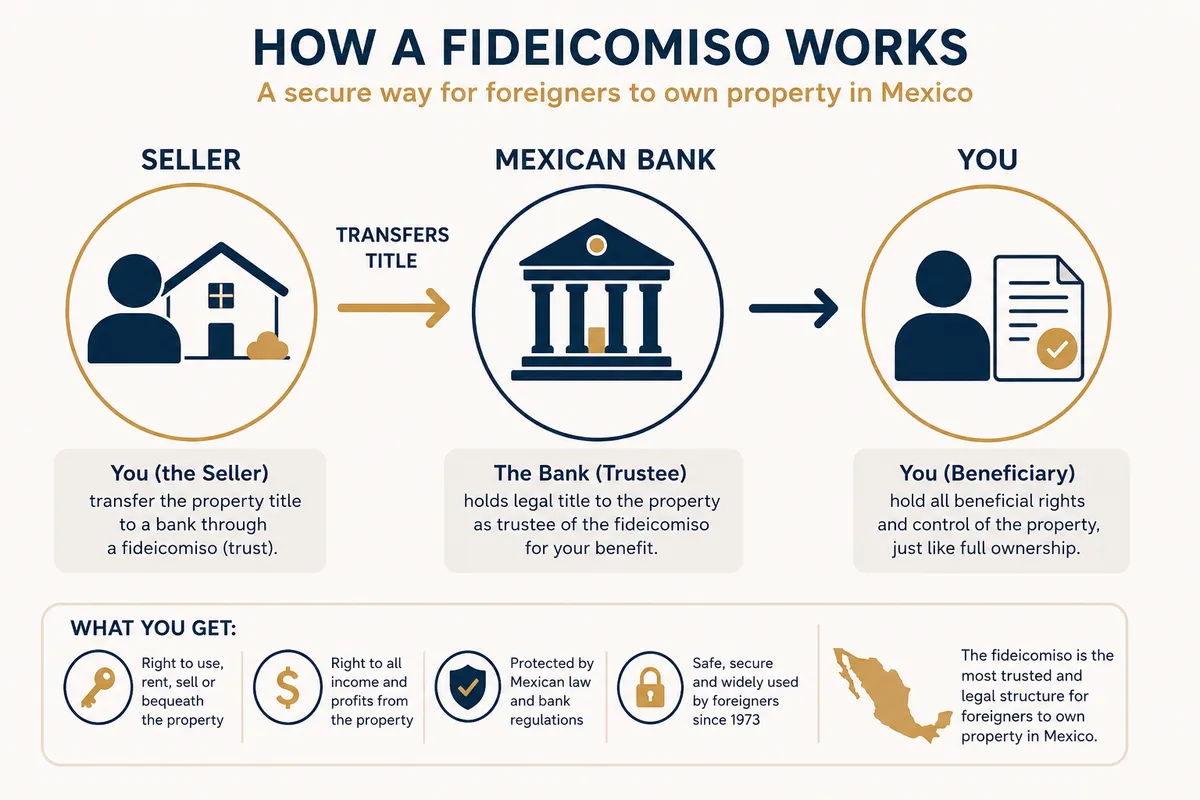
A fideicomiso, or Mexican bank trust, allows foreigners to legally buy, use, sell and inherit residential property within Mexico's restricted zone...including La Paz and most of Baja California Sur. Although a Mexican bank holds title as trustee, you remain the beneficiary and control the property. You decide when to sell it, rent it, improve it or pass it to your heirs.
The short answer
A fideicomiso is a renewable 50-year Mexican bank trust used by many foreign buyers to own residential property within Mexico's restricted zone. The bank acts as trustee and holds title on behalf of the foreign buyer, who is named as the beneficiary. The beneficiary controls the property and may occupy it, renovate it, rent it, sell it or leave it to designated substitute beneficiaries such as their children or other family members or friends.
If you are an American, Canadian or other non-Mexican buying a home in La Paz or elsewhere near Mexico's coastline, a fideicomiso is the most common ownership structure you are likely to encounter.
THE BASICS
What is a fideicomiso?
A fideicomiso inmobiliario, commonly called a fideicomiso or bank trust, is a legal structure that allows a foreign buyer to hold beneficial rights to real estate located within Mexico's constitutionally restricted zone. The property is placed in a trust administered by a Mexican bank authorized to act as trustee. The bank appears on title as the fiduciary, while the foreign purchaser is named as the beneficiary of the trust. that distinction sometimes sounds alarming to buyers accustomed to fee-simple ownership in the United States or Canada, but hte bank does not use the home as its own asset or make everyday decisions about the property. Those rights belong to the beneficiary under the terms of the trust.
Fideicomiso literally means "trust". You may also hear the terms bank trust, property trust, real estate trust, or Mexico property trust. In foreign-buyer transactions, they are usually referring to the fideicomiso structure.
FOREIGN OWNERSHIP RULES
What is Mexico's Restricted Zone?
Mexico's restricted zone is the area within 50 kilometers (about 31 miles) of the coastline and 100 kilometers (about 62 miles) of an international border.
Under Article 27 of the Mexican Constitution, foreigners cannot hold direct title to land within this zone. However, Mexican law provides a well-established legal structure that allows foreign individuals to use and enjoy residential property in these areas through a fideicomiso, or Mexican bank trust. Because La Paz and many of Baja California Sur's most desirable communities are located close to the Sea of Cortez or Pacific Ocean, foreign buyers purchasing residential property here will commonly use a fideicomiso.
If you know an American, Canadian, or other non-Mexican who owns property near Mexico's coastline, there's a very good chance they own it through a fideicomiso. this is the standard structure used by foreign buyers in many of Mexico's most desirable coastal destinations, including Cabo San Lucas, San Jose del Cabo, La Paz, Puerto Vallarta, Punta Mita, Cancun, Playa del Carmen, Tulum, Cozumel, Mazatlan, Loreto, and the Riviera Maya. In other words, a fideicomiso isn't an unusual workaround - it's how countless foreign owners legally and securely hold property in Mexico's restricted coastal zone.
50 km
From Mexico's coastline
100 km
From Mexico's international borders
50 Years
Fideicomiso term, renewable
These geographic restrictions affect the method of ownership - not a foreign buyer's ability to purchase and enjoy residential property.
YOUR RIGHTS
Do You Really Own the Property Through a Fideicomiso?
This is usually the first concern American and Canadian buyers have they they hear that a Mexican bank will appear on title.
The bank acts as fiduciary, or trustee, while you are named as the beneficiary of the fideicomiso. The trust exists for your benefit and give you teh right to use and enjoy the property under the terms of the trust. Mexican foreign-investment law specifically recognizes the beneficiary's rights to the use and enjoyment of the property within the restricted zone, including the ability to receive income or other economic benefits generated by it.
In practical terms, the fideicomiso is the legal vehicle through which you control your residential property in Mexico.
The bank is the trustee. You are the beneficiary. The bank does not become your landlord or decide how you live in your home.
What can I do with the property?
LIVE IN IT
Use the home personally or as a vacation property.
IMPROVE IT
Renovate or improve the property, subject to local permits, HOA rules, etc.
RENT IT
Generate rental income, subject to Mexican tax, licensing and applicable requirements.
SELL IT
Sell your beneficial interest or transfer the property as part of a future transaction.
PASS IT ON
Name substitute beneficiaries who may receive your rights in the trust - such as your children.
CONTROL IT
Exercise the rights granted to you as beneficiary under the ficeicomiso.
Does the Mexican bank control my property?
No! The bank acts as trustee of the fideicomiso and holds its interest in that fiduciary capacity. The foreign buyer is the beneficiary and exercises the use and enjoyment rights provided by the trust. The bank does not move into the property, rent it to someone else or independently decide to sell it.
HOW IT WORKS
How Does a Fideicomiso Work?
Think of the fideicomiso as a legal bridge between Mexico's constitutional restrictions on direct foreign ownership in coastal areas and a foreign buyer's ability to purchase residential property there.
1
You choose the property
You negotiate the purchase just as you would with another real estate transaction, including price, terms, deposits, due diligence and closing conditions.
2
A Mexican bank is selected as trustee
The fiduciary requests authorization from the Secretaria de Relaciones Exteriores (SRE) for the trust involving
3
Permission is obtained from Mexico's Foreign Affairs Ministry
The fiduciary requests authorization from the Secretaria de Relaciones Exteriores (SRE) for the trust involving property in the restricted zone.
4
The fideicomiso is created at closing
The trust agreement forms part of the transaction documentation and is formalized through a Mexican Notary Public.
5
You become the beneficiary
Once the transaction is completed, the bank serves as trustee and you hold the beneficial rights (and control of the property) established in the fideicomiso.
TERM & RENEWAL
How Long Does a Fideicomiso Last?
A fideicomiso established for property within Mexico's restricted zone may have a term of up to 50 years. That does not mean you lose your property after 50 years. Mexican foreign-investment law expressly provides that the term may be extended at the request of the interested party. In practice, the remaining term of an existing fideicomiso is therefore an important item to review when purchasing a property that is already held in trust. Depending on the transaction, the existing trust may be assigned or modified, or a new fideicomiso may be established.
MYTH!
"My fideicomiso expires after 50 years and the Mexican government takes my house."
REALITY
The statutory fideicomiso term is up to 50 years, but Mexican law allows the duration to be extended upon request. The expiration date should be monitored and addressed property as part of the trust adminstration. Technically, your fideicomiso can be renewed indefinitely...forever.
SELLING YOUR PROPERTY
Can You Sell Property Held in a Fideicomiso?
Yes. A fideicomiso does not prevent you from selling the property. When you sell, the transaction is coordinated through the closing process and a Mexican Notary Public. Depending on your circumstances, the buyer may receive rights through the existing fideicomiso, the trust may be modified, or a new ownership structure may be created for the purchaser. If the new buyer is Mexican, the property may also be transferred out of the fideicomiso and into direct Mexican ownership, depending on the transaction. As with any Mexican real estate seal, taxes, closing costs, bank requirements and documentation should be reviewed before the transaction is completed.

ESTATE PLANNING
What Happens to a Fideicomiso When the Owner Dies?
A fideicomiso can provide a practical mechanism for transferring the beneficiary's rights after death. When a trust is created, the buyer can typically designate one or more substitute beneficiaries who may receive the beneficiary's rights under the fideicomiso upon death. Mexican regulations expressly contemplate the identification of substitute beneficiaries in the fideicomiso application.
This makes beneficiary designation an important part of the purchase process rather than something buyers should treat as an afterthought.
Important:
A fideicomiso beneficiary designation should be coordinated with your broader estate plan. Cross-border estates can involve Mexican law as well as the laws and tax rules of your home country, so individualized legal and tax advice is appropriate.
COSTS & FEES
How Much Does a Fideicomiso Cost?
A fideicomiso involves both initial setup costs and ongoing annual bank administration fees. The exact cost depends on the trustee bank, the structure of the transaction and the services required to establish or modify the trust. There is also a federal government fee associated with obtaining permission from Mexico's Secretaria de Relaciones Exteriores to establish a fideicomiso within the restricted zone. For 2026, the official SRE free for issuing that permission is $21,560 MXN (as of September 3rd, 2026, that converts to approximately $1,275.00 USD). These costs are normally included as part of the buyer's overall closing-cost estimate. Government fees may change from year to year.
GOVERNMENT PERMIT
$21,650 MXN (approx $1,275 USD) in 2026
Official SRE fee for permission to establish a fideicomiso in Mexico's restricted zone.
BANK SETUP FEE
Varies by bank - in La Paz, usually close to $1200 USD
Charged by the financial institution acting as trustee when the fideicomiso is established.
ANNUAL TRUST FEE
Varies by bank - in La Paz, usually close to $600 USD per year.
Ongoing administration fee paid to the trustee bank for maintaining the fideicomiso.
Ask for the complete cost before closing. A buyer should understand the initial fideicomiso costs, annual bank fee and any future bank charges for amendments, beneficiary changes or transfers. When you work with Dream Baja Realty, we will ensure you have a full estimate of closing costs prior to submitting an offer.
Does a fideicomiso have to be paid every year?
Yes.
The Mexican bank serving as trustee generally charges an annual administration fee for maintaining the fideicomiso. The amount varies by bank, but in La Paz usually amounts to approximately $600 usd per year.
EXISTING TRUSTS
What If the Property Already Has a Fideicomiso?
Many resale properties in La Paz and other coastal markets are already held in a fideicomiso because the current owner is also a foreign buyer. That does not necessarily mean the buyer simply "takes over" the existing trust unchanged. During the closing process, the Notary Public, trustee bank and closing professionals review the existing fideicomiso, its remaining term and the proposed ownership structure for the new buyer. Depending on the transaction, the trust may be assigned or amended, or a new fideicomiso may be established. The important point for a buyer is that the existing trust documentation should be reviewed as part of the property's legal due diligence.
Four things to verify:
01
TRUSTEE BANK
Which Mexican bank currently administers the fideicomiso?
02
REMAINING TERM
How many years remain on the existing trust?
03
BENEFICIARIES
Who is currently named as beneficiary and substitute beneficiary?
04
TRUST STATUS
Are the bank fees current and is the fideicomiso documentation in good standing?
DID YOU KNOW?
A property being held in a fideicomiso is not unusual in Baja California Sur. It is simply the ownership structure commonly used by foreign residential buyers within Mexico's restricted coastal zone.
OWNERSHIP STRUCTURES
Fideicomiso vs. Mexican Corporation: Which is Better?
Foreign buyers sometimes hear that they can avoid a fideicomiso by creating a Mexican corporation. The two structures serve different purposes, and a corporation is not automatically the better, or simpler, option. For an individual purchasing a home primarily for personal residential use within the restricted zone, a fideicomiso is the ownership structure commonly used.
Mexican companies with foreign participation may directly own property within the restricted zone when the property is used for qualifying non-residential purposes, but corporate ownership also introduces accounting, tax, reporting and compliance obligations.
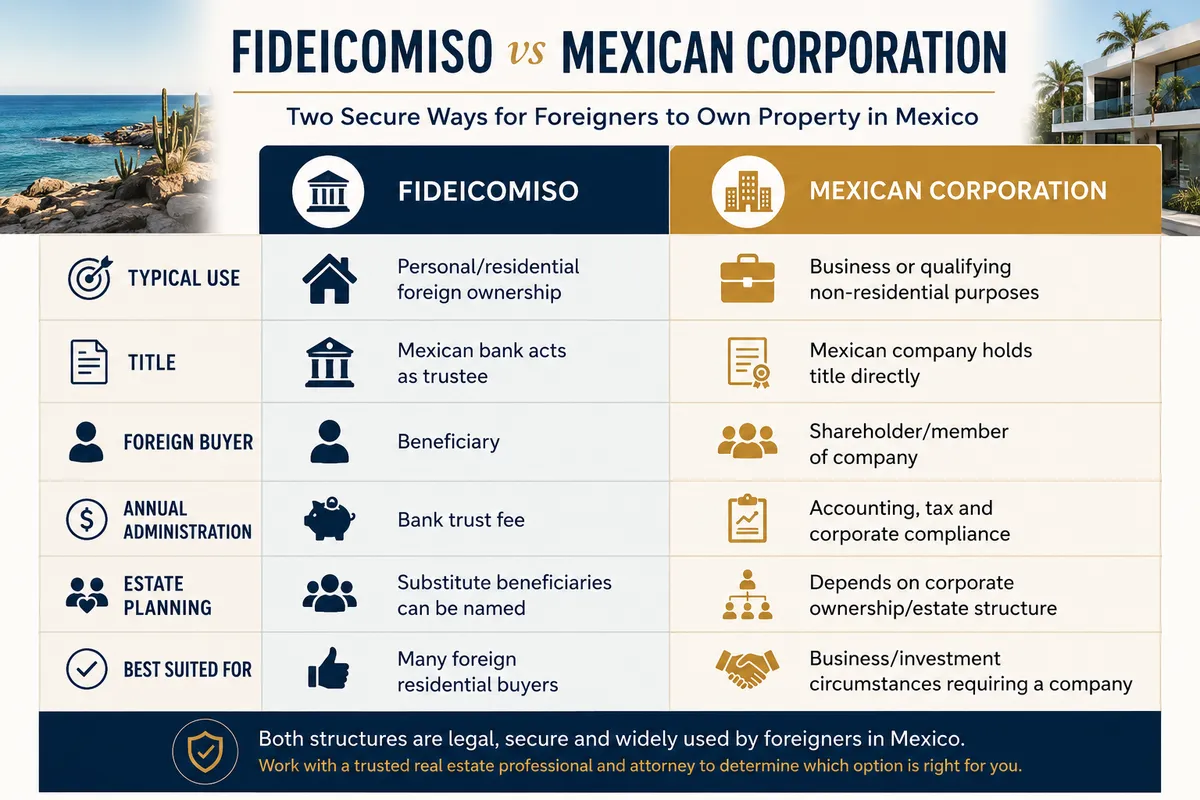
Do not choose an ownership structure simply to avoid a bank fee. The correct structure should be based on how the property will actually be used, the buyer's tax situation, ownership goals and professional legal/accounting advice.
Can I form a Mexican corporation instead of using a fideicomiso?
Sometimes, but the structures are not interchangeable. A Mexican company with foreign participation may directly own restricted-zone real estate for qualifying non-residential purposes. Foreign buyers acquiring residential property for personal use typically use a fideicomiso. The appropriate structure should be determined with Mexican legal and tax advisors.
BUYER CONFIDENCE
Is a Fideicomiso Safe?
A fideicomiso is not an informal workaround or private arrangement. It is the legal mechanism specifically provided under Mexican foreign-investment law for foreigners to use and enjoy real estate within the restricted zone. The trust is administered by an authorized Mexican financial institution, requires permission from the Secretaría de Relaciones Exteriores and must be documented in a public deed.
As with any real estate transaction, however, the safety of the purchase depends on proper due diligence. Buyers should verify title, liens, property documentation, permits where applicable, taxes, trust documentation and the identity and authority of the seller before closing.
The fideicomiso itself is not the risk. Poor due diligence is the risk.
AUTHORIZED BANK
The trustee is a Mexican financial institution authorized to act in that fiduciary capacity.
GOVERNMENT PERMISSION
Restricted-zone fideicomisos require authorization through Mexico's Foreign Affairs Ministry.
PUBLIC DEED
The fideicomiso agreement must be documented in a public registered deed.
NOTARY OVERSIGHT
The real estate conveyance is formalized through a Mexican Notary Public.
Can the bank take my house?
The bank acts as trustee under the fideicomiso rather than as the economic beneficiary of the property. Your rights are governed by the trust agreement. Any specific concern about a trustee bank, trust provision or creditor issue should be reviewed with qualified Mexican counsel. The short answer? No, the bank cannot take your house.
What if the bank fails?
Mexican fiduciary arrangements are governed separately from the bank simply treating the property as its own asset. If a buyer has concerns about trustee-bank insolvency or replacement, those issues should be reviewed with the Notary Public, trustee bank, and legal counsel before closing. In 2025, Intercam Banco was bought by Kapital Bank. Kapital Bank simply assumed the trusts, with no changes to fees.
Can the Mexican government take my property?
A fideicomiso does not give the Mexican government ownership of your home. It is the legal framework Mexico provides for foreign beneficiaries to use and enjoy residential property within the restricted zone. Property owners remain subject to Mexican laws, taxes and legal processes just as owners are subject to law in other countries.
Does the bank decide when I can sell?
The trustee participates in formal transactions involving the trust, but the fideicomiso is established for the beneficiary's use and enjoyment. A sale or transfer must be handled according to the trust agreement and Mexican closing requirements. Mexico's own consular guidance states that the foreign beneficiary may use, enjoy, sell and inherit the rights associated with the property.
A NORMAL PART OF COASTAL OWNERSHIP
Fideicomisos Are Common Across Mexico's Most Popular Coastal Markets
If you know an American, Canadian or other non-Mexican who owns a home near Mexico's coastline, there is a very good chance their property is held through a fideicomiso. That includes foreign homeowners in places such as La Paz, Cabo San Lucas, San Jose del Cabo, Todos Santos, Loreto, Puerto Vallarta, Punta Mita, Cancun, Playa del Carmen, Tulum, Cozumel and many other coastal communities.
The fideicomiso is not something unique to Baja or an unusual arrangement created for a particular development. It is the established structure used throughout Mexico's restricted zone to allow foreign beneficiaries to use and enjoy residential real estate.
FACT VS FICTION
Common Fideicomiso Myths Explained
Fideicomisos can sound complicated when you first encounter them, and there is plenty of outdated or misleading information online. Here are some of the misconceptions we hear most often from foreign buyers.
Myth #1
"Foreigners can't own property in Mexico."
Reality:
Foreigners can legally acquire real estate throughout Mexico. Outside the restricted zone, foreigners may generally acquire direct title subject to applicable requirements. Within the restricted zone - 100 kilometers from an international border and 50 kilometers from the coastline - foreign residential buyers commonly hold their rights through a fideicomiso.
Myth #2
"The bank owns my house and can do whatever it wants with it."
Reality:
The Mexican bank acts as trustee under the fideicomiso. The trust is established so the foreign beneficiary can use and enjoy the property. The bank's role as trustee is fundamentally different from being the person who occupies or economically benefits from the home.
Myth #3
"After 50 years, Mexico takes the property back."
Reality:
A restricted-zone fideicomiso may be established for up to 50 years, and Mexican law provides a process for extending its duration. The 50-year term is therefore something to administer and monitor - not a countdown to government confiscation. The SRE currently publishes a specific procedure and government fee for extending a fideicomiso's duration.
Myth #4
"I need Mexcan residency to buy a home."
Reality:
Mexican residency is not a prerequisite for a foreign buyer to purchase residential property through a fideicomiso. Your immigration status and your property ownership structure are separate legal concepts.
Myth #5
"A Mexican corporation is always better because there is no bank trust fee."
Reality:
A corporation and a fideicomiso serve different purposes. Corporate ownership introduces accounting, tax, reporting and compliance considerations and should not be selected simply to avoid the annual administration fee of a fideicomiso."
The right question is not "How do I avoid a fideicomiso?"
It is "What ownership structure is appropriate for how I intend to use the property?"
FREQUENTLY ASKED QUESTIONS
Fideicomiso FAQs for Foreign Property Buyers in Mexico
These are some of the most common questions we receive from Americans, Canadians and other international buyers considering property in La Paz and Baja California Sur.
What is a fideicomiso in Mexico?
A fideicomiso is a Mexican bank trust commonly used to allow foreign buyers to hold beneficial rights to residential property within Mexico's restricted zone. A Mexican bank acts as trustee and the foreign buyer is named as beneficiary. The structure allows the beneficiary to use and enjoy the property while complying with Mexico's restrictions on foreign ownership of land close to coastlines and international borders.
In plain English: it's simply the standard way many foreign buyers own coastal property in Mexico.
Can an American buy property in Mexico?
Yes. Americans can legally purchase property in Mexico. When residential property is located within Mexico's restricted zone, an American buyer will commonly acquire the beneficial rights through a fideicomiso. Outside the restricted zone, different ownership structures may apply.
So, yes - you can absolutely buy a home in Mexico as an American.
Can a Canadian own property in Mexico?
Yes. Canadians can purchase Mexican real estate under the same foreign-investment framework that applies to other non-Mexican buyers. For residential property within the restricted coastal or border zone, a fideicomiso is very commonly used.
Canadian buyers do this every day, and the process is well established.
Do I need Mexican residency to buy property?
No. Foreign property ownership and Mexican immigration residency are separate matters. A foreign buyer does not generally need temporary or permanent Mexican residency simply to purchase residential property through a fideicomiso.
You do not need to become a resident first - you can buy while still living in the U.S. or Canada.
Can foreigners buy beachfront property in Mexico?
Yes, using the appropriate legal ownership structure. Because beachfront property falls within Mexico's restricted zone, foreign residential buyers commonly hold their rights through a fideicomiso rather than taking direct title personally.
When your dream home is near the beach, a fideicomiso makes it legally possible for you to own it.
How close to the ocean does the restricted zone extend?
Mexico's restricted zone extends 50 kilometers (approximately 31 miles) from the coastline and 100 kilometers (approximately 62 miles) from an international border.
When you're buying in La Paz or most popular Baja California Sur communities, just expect a fideicomiso to be part of the process.
How long does a fideicomiso last?
A fideicomiso used for restricted-zone property may be established for up to 50 years. Its duration can be extended through the applicable legal process, so reaching the end of the original term does not automatically mean losing the property.
The 50-year term is not an expiration date on your ownership - it's simply a trust term that can be extended and renewed.
Is a fideicomiso renewable?
Yes. Mexican law provides for extending the duration of a fideicomiso, and the Secretaria de Relaciones Exteriores maintains an official procedure for doing so.
So you don't need to worry that your rights suddenly disappear when the original term ends.
How much does a fideicomiso cost?
As of 2026, costs include government charges and fees from the trustee bank. As of 2026, the official SRE fee for permission to establish a fideicomiso within the restricted zone is $21,650 MXN (approx $1275.00 USD as of September 2026). The trustee bank's setup and annual administration fees are separate and vary by institution. This fee will be included in your closing costs when purchasing a property.
Think of it as one of the normal costs of owning coastal property in Mexico, much like other closing and administration expenses.
Is there an annual fideicomiso fee?
Yes. The bank serving as trustee generally charge an annual administration fee. The amount depends on the institution and the terms of the trust. In La Paz, the annual fideicomiso fee is generally between $500 USD and $600 USD per year, and the first year's fee is included in your closing costs when buying a property.
It's a predicable annual ownership expense, not something that should stop you from buying the right property.
Can I sell a house held in a fideicomiso?
Yes. Property held though a fideicomiso can be sold. The sale is coordinated with the trustee bank, Mexican Notary Public and other closing professionals so that the buyer receives the appropriate ownership or beneficial rights.
You are not locked in - you can sell when the time is right for you.
Can I rent my fideicomiso property?
Yes. A fideicomiso permits the beneficiary to receive economic benefits from the property. Rental activity remains subject to applicable Mexican tax, licensing, immigration, condominium and local requirements that don't depend on your ownership structure.
Your property can work for you and generate rental income, provided you follow the applicable local rules.
Can I leave a fideicomiso property to my children?
Yes. A fideicomiso can name substitute beneficiaries who may receive the beneficiary's rights following death. This makes beneficiary designation an important part of establishing the trust. In fact, owning via fideicomiso can make passing on the property via inheritance a clear and smooth process compared to direct ownership in Mexico.
You can 100% plan for your property to stay in the family.
Does the bank control my property?
No. The bank acts as trustee rather than the person using the property for its own benefit. The beneficiary's rights are established by the fideicomiso agreement, and formal transactions involving the property are carried out according to the trust and Mexican law.
The bank handles the trust structure - you remain the person making the real-world decisions about your property.
Do I need a lawyer to create a fideicomiso?
A Mexican Notary Public plays a required role in formalizing the real estate transaction and public deed. Many foreign buyers also choose to work with an independent closing attorney who can review documents and represent their interests during the purchase.
You don't need to figure any of this out alone - the right professionals, including Dream Baja Realty, guide the process from start to finish.
BUY WITH CONFIDENCE
You Don't Have to Navigate a Fideicomiso Alone
Buying property in another country involves more than finding the right home. It also means understanding a different closing system, coordinating documents, deadlines, banks, escrow, due diligence and the Mexican Notary Public.
Dream Baja Realty helps foreign buyers navigate that process from the initial property search through closing and beyond.
When a fideicomiso is required, we help keep the transaction moving by coordinating the professionals involved, explaining what is happening at each stage and helping you understand what is needed next.
Property search & negotiation
Offer and contract coordination
Escrow coordination
Due-diligence support
Fideicomiso and bank coordination
Closing & post-closing guidance
Local Expertise. International-buyer Experience.
Dream Baja Realty is a La Paz-based real estate brokerage helping Mexican and international clients buy, sell and relocate throughout Baja California Sur. Our team regularly works with ownership structures, professionals and closing processes involved in foreign-buyer transactions.
AMPI • La Paz, Baja California Sur • Foreign Buyer Specialists

KEEP LEARNING
Planning to Buy Property in Baja?
A fideicomiso is only one part of buying in Mexico. These Dream Baja Realty guides will help you understand the rest of the process.
BUYING PROPERTY IN LA PAZ, MEXICO
The complete foreign buyer's guide to finding a property, making an offer, due diligence, escrow and closing.
CLOSING COSTS WHEN BUYING PROPERTY IN MEXICO
Understand acquisition tax, Notary costs, registration, trust expenses and other common closing charges.
CAN FOREIGNERS BUY PROPERTY IN MEXICO?
The ownership rules Americans, Canadians and other foreign buyers should understand before beginning their search
MOVING TO LA PAZ, MEXICO
Explore lifestyle, healthcare, neighborhoods, climate, transportation and the practical side of relocating to Baja.
EXPLORE LA PAZ REAL ESTATE
Search available homes, condos and property throughout La Paz and surrounding communities.
READY TO START?
Thinking About Buying in Baja?
Whether you're actively looking for a home or simply trying to understand how ownership in Mexico works, we're happy to answer your questions. Tell us what you're considering and we'll help you understand the property search, fideicomiso, closing process and next steps.
No pressure. Just practical answers from a local real estate team that works with foreign buyers.
Dream Baja Realty
Calle Delfines 135
entre Mangle y Oceano Pacifico,
Col. Esperanza I, La Paz, 23090 Mexico
Limitation of Liability: Dream Baja Realty, is a real estate company that offers third party real estate, therefore all information published on this site, is deemed reliable but not guaranteed and should be verified with one of our advisers in order to confirm whether the advertised properties are subject to lease, sale, change or withdrawal. Dream Baja Realty will not be responsible for any typographical errors, misinformation, misprints and in no case be considered as misleading advertising or bad faith. Dream Baja Realty is a proud member of MLS BCS. Please enjoy this website advertising all brokerage members MLS listings for public review.
The offered price is in DOLLARS (US Currency) and in accordance with article 8 of the monetary law, the final price for recordation purposes will be converted into PESOS resulting from the official exchange rate on the date payment is due. Prices shown in DOLLARS can be converted into PESOS by accessing the following link and performing the corresponding arithmetic multiplication per the current exchange rate. https://www.banxico.org.mx/tipcamb/main.do?page=tip&idioma=en