

FOREIGN BUYER BUYING PROCESS IN MEXICO
Buying Property in Mexico: The Step-by-Step Process
Buying a home in Mexico is different from buying in the United States or Canada, but once you understand the process, it is surprisingly straightforward.
This guide walks you through the typical purchase process in La Paz and Baja California Sur, from choosing the right property through due diligence, escrow, fideicomiso and final closing
THE SHORT VERSION
How Does Buying Property in Mexico Work?
For most buyers, the process follows a predictable sequence:
Find a licensed, AMPI-member brokerage with access to MLS listings covering Baja California Sur
Find the right property
Make an offer, negotiate to acceptance
Deposit earnest money into escrow and fund 50% of the estimated closing costs
Complete legal and property due diligence
Establish or transfer the fideicomiso if required
Prepare the transaction through the closing attorney and Notario
Fund the purchase and remaining closing costs
Sign the final deed
Complete registration and receive your ownership documents
Typical timing: approximately 60 - 90 days for many resale transactions, although every closing is different.
In simple terms: buying in Mexico involves more paperwork than most people are used to, but you don't have to manage it yourself. A good team coordinates the process around you.
YOUR ROADMAP
The Mexico Property Buying Process at a Glance
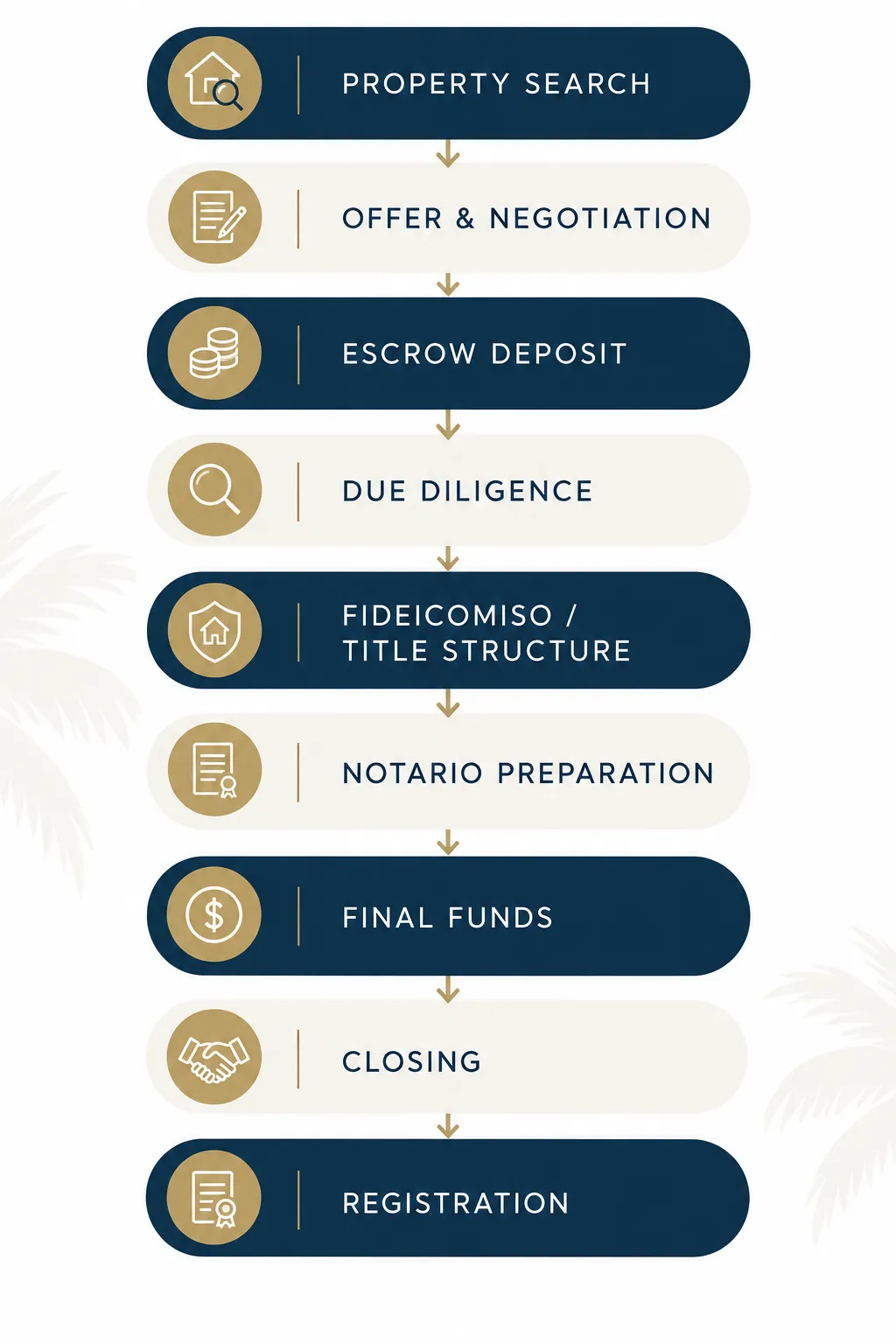
The details vary depending on the property, ownership structure and buyer, but most Baja California Sur residential transactions follow this general path.
STEP 1
Define What You Want to Buy - and Your Real Budget
Before looking at individual properties, establish the type of purchase you're actually trying to make.
Consider:
Full-time residence
Vacation home
Retirement property
Rental or investment property
Condo
Single-family home
New construction
Pre-construction
Land
Then determine your total acquisition budget, not just the property price.
For example, if your total available budget is approximately $450,000 USD, buying a $450,000 property may leave you without enough funds for closing expenses.
A more realistic property-search budget might be closer to $415,000 - $425,000, depending on the transaction.
In simple terms: decide what you're comfortable spending all-in before falling in love with a property.
STEP 2
Find the Right Property
Your search may include:
MLS-listed resale properties
Developer inventory
New construction
Pre-construction developments
Off-market opportunities
Land
For foreign buyers, especially, the property itself is only part of the decision.
You should also evaluate:
Neighborhood
Title status
Existing Fideicomiso
HOA or condo regime
Utilities
Property taxes
Construction condition
Access
Rental restrictions
Future development
Seller documentation
Potential resale appeal
Don't evaluate a Mexican property only by comparing price per square foot.
Location, title structure, infrastructure, construction quality, ocean views, community amenities and inventory can have a major effect on value.
STEP 3:
Submit and Negotiate the Offer
Once you've chosen a property, your real estate advisor prepares an offer outlining the principal terms of the proposed purchase.
Depending on the transaction, the offer may address:
Purchase Price
Currency
Earnest money
Escrow
Closing date
Due-diligence period
Furnishings
Possession
Contingencies
Closing Expenses
Fideicomiso considerations
Buyer and Seller obligations
The seller may:
Accept - Reject - Counter
Negotiation continues until both parties agree on the principal terms.
Important buyer point: Mexico transactions can involve both USD and Mexican pesos, so the contract should clearly establish how the purchase price and payments are denominated.
Avoid leaving the exchange-rate treatment ambiguous.
In simple terms: your offer isn't just about price. this is where you establish the rules for how the transaction will proceed.
STEP 4:
Formalize the Agreement
Once the parties agree on the commercial terms, those terms are documented in the applicable purchase agreement or promissory agreement. Sometimes, these terms have already been established in the formal offer, and in this case an additional contract may not be needed.
The exact contract structure can vary from transaction to transaction.
Either the formal signed and accepted offer, or the purchase agreement, should clearly establish matters such as:
Buyer and seller
Property being purchased
Purchase price
Deposit
Payment schedule
Closing date
Default provisions
Required documentation
Conditions or contingencies
Possession
Transaction Expenses
The private purchase contract or the accepted offer are not the final deed transferring title.
The legal transfer of Mexican real property is ultimately formalized through the deed prepared and authorized through the Notario Publico.
In simple terms: this contract commits the parties to the deal; the final deed is what formally completes the property transfer
STEP 5:
Fund the Earnest Money Deposit
After the agreement is signed, the buyer typically deposits the agreed earnest money according to the contract.
For international transactions, professional escrow is commonly used so purchase funds can be held by an independent party rather than being paid directly to the seller before closing.
The escrow agreement establishes:
Who controls the account
Conditions for release
Refund provisions
Required authorizations
Closing instructions
Is escrow mandatory in Mexico?
Escrow is not identical to the U.S. system and isn't necessarily legally required in every transaction.
However, professional escrow can provide an important layer of protection and accountability, especially for international buyers.
In simple terms: escrow helps keep your money separate from the seller until the conditions for releasing it have been satisfied.
STEP 6:
Verify the Property Before Closing
This is one of the most important stages of the transaction. The closing professionals and Notario will review documentation associated with the property and seller.
Depending on the transaction, this can involve reviewing or obtaining:
* Existing deed or fideicomiso
* Seller identity and authority
* Property description
* Cadastral information
* Property-tax status
* Liens and encumbrances
* HOA or condominium information
* Utility obligations
* Existing debt or mortgages
* Permits or construction documentation
* Corporate documentation where applicable
Should I get a home inspection?
For a resale property, we generally recommend that buyers consider an independent inspection appropriate to the property.
An inspection can identify issues such as:
Electrical systems
Plumbing
Air conditioning
Roof condition
Pool equipment
Structural conditions
Water systems
General maintenance
In simple terms: buying a beautiful home isn't enough. You also want to know that the legal and physical property you're buying matches what you think you're buying.
STEP 7:
Determine How You Will Hold Title
For Mexican citizens, residential property can generally be held through direct title.
Foreign buyers purchasing residential real estate in much of Baja California Sur will normally use a fideicomiso because the property is within Mexico's restricted zone.
Mexico's Secretaria de Relaciones Exteriores confirms that the restricted zone extends 50 kilometers from the coastline and 100 kilometers from international borders. Foreigners may use residential real estate in that zone through an authorized fideicomiso.
A fideicomiso permit may authorize the structure for up to 50 years, and the trust is documented in the public deed.
Dream Baja Realty rule of thumb:
Never send significant transaction funds simple because someone emailed wire instructions. We advise our clients to use third party escrow to protect their money, and to independently verify recipient details and the transaction process before sending money.
In simple terms: If you're American or Canadian buying a home in La Paz, the fideicomiso is a normal part of the process - not a workaround or unusual exception.
STEP 8:
The Notario Publico Prepares the Legal Transfer
The Notario Publico is a specially authorized legal professional who formalizes the real estate transfer and prepares or authorizes the deed.
The Notario's work may include coordinating documentation, calculating applicable taxes and fees, confirming legal requirements and completing the formal transfer process.
A Mexican Notario is not the same as a U.S. or Canadian notary public.
The role carries substantially greater legal authority and responsibility.
STEP 9:
The Fideicomiso Is Created or Transferred
If the buyer requires a fideicomiso, the closing team coordinates the bank and required federal authorization.
The Secretaria de Relaciones Exteriores currently requires fideicomiso applications for restricted-zone property to be submitted electronically through its system and identifies information such as the trustee bank, beneficiary, term, property description and intended use among the required elements.
Step 10:
Know Exactly What You Need to Fund
As closing approaches, the transaction team will calculate the remaining funds required. None of these should be a surprise, and should have been included in your closing costs estimate prior to your offer being presented.
Your closing statement may include:
* Remaining purchase balance
* Acquisition tax
* Notario expenses
* Registration costs
* Fideicomiso expenses
* Government fees
* Escrow expenses
* Other transaction-specific charges
STEP 11:
Transfer the Purchase Funds
The buyer sends the required funds according to the closing instructions and contract. For international buyers, this commonly involves a wire transfer. Before the funds are due, ensure you've spoken to your bank to understand how long the wire transfer should take to arrive so you can prevent delays at closing.
STEP 12:
Complete the Property Transfer
At closing, the legal instruments required to transfer the property are executed through the Notario process.
Depending on the transaction and buyer circumstances, documents may be signed:
* In person
* Through an authorized representative
* Through a properly prepared power of attorney where appropriate.
Once the conditions for closing and release of funds have been satisfied, the transaction proceeds to completion.
*Important: If you know you won't be available in person to sign at the closing, you should have a power of attorney created for someone you trust to sign on your behalf before leaving Mexico. It's much more difficult to create a power of attorney that will be valid for the closing from outside the country.
In simple terms: this is the point where all the work done during the previous weeks comes together and the property formally becomes yours.
STEP 13: AFTER SIGNING
What Happens After Closing?
One important difference for foreign buyers to understand is that signing day is not necessarily the end of the administrative process.
After closing, the deed must proceed through the appropriate registration process.
That means you may receive keys and possession before receiving the final registered deed or fideicomiso documentation.
This is normal.
Registration is an administrative step following the execution of the transaction and can take additional time.
Your closing team should keep you informed until the final registered documentation is available.
AFTER CLOSING
Buying the Property Is Only the Beginning
For someone relocating from the United States or Canada, closing often starts a completely different list of questions:
Electricity
Water
Internet
Property management
HOA
Home insurance
Contractors
Furnishings
Vehicle
Immigration
Banking
Utilities
Local services
Dream Baja Realty doesn't disappear once you receive the keys.
Our team helps clients connect with the local resources they need to begin enjoying their property and life in Baja California Sur.
TIMELINE
How Long Does It Take to Buy Property in Mexico?
For many resale transactions in Baja California Sur, a practical planning range is approximately 60-90 days from accepted offer to closing.
Some transactions can move faster, while others take longer depending on factors such as:
Whether a new fideicomiso must be created
Trustee Bank processing times
Seller documentation
Property title history
Existing liens or mortgages
Appraisal and certificate timing
Notario workload
Buyer financing
Powers of attorney
New-construction documentation
Federal or municipal approvals
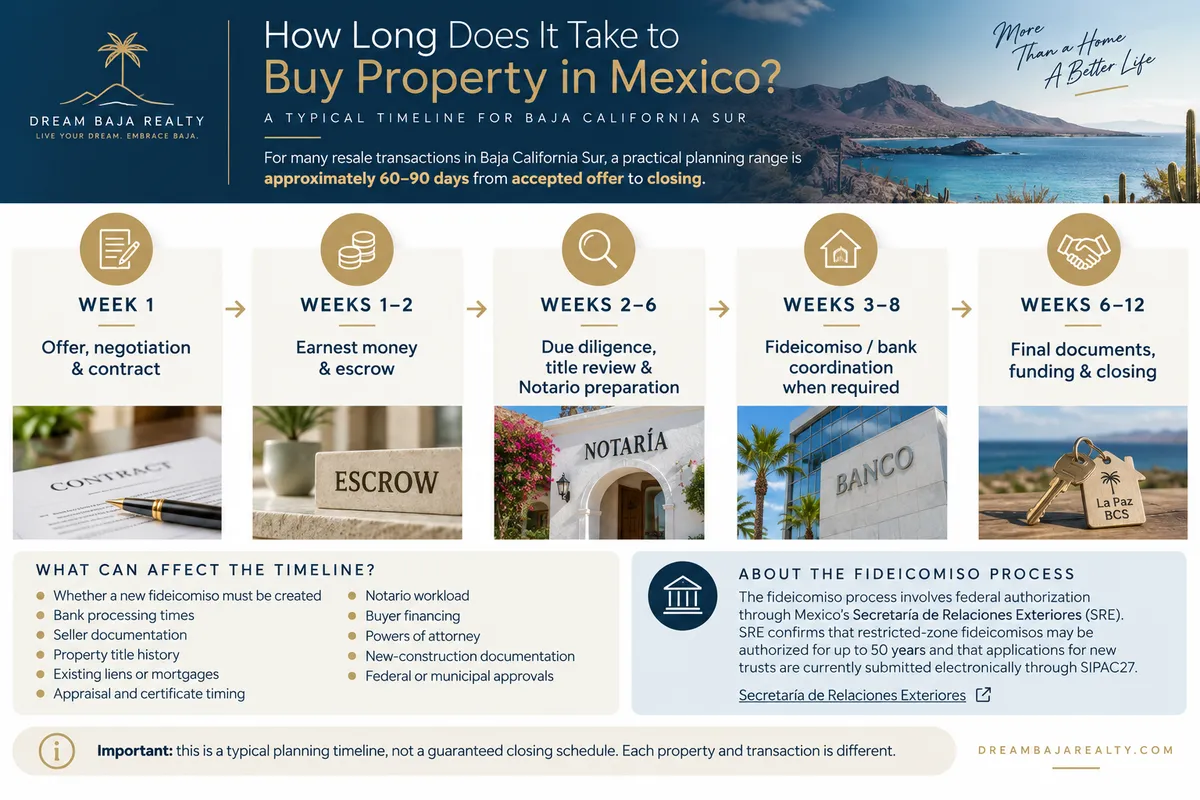
In simple terms: plan on roughly two to three months for a typical resale purchase, and treat a faster closing as a bonus rather than an expectation.
BUYER FAQ
Frequently Asked Questions About Buying Property in Mexico
Can Americans and Canadians legally buy property in Mexico?
Yes. Foreigners can legally purchase real estate in Mexico.
Outside Mexico's restricted zone, qualifying foreign buyers can generally acquire direct title subject to Mexican law. Within the restricted zone — 100 kilometers from an international border and 50 kilometers from the coastline — foreign buyers purchasing residential property normally hold their rights through a fideicomiso with a Mexican bank. Secretaría de Relaciones Exteriores
The simple version: foreigners buy homes throughout Mexico every day, including coastal destinations such as La Paz, Los Cabos, Puerto Vallarta, Cancun and Playa del Carmen.
Can a foreigner own beachfront property in Mexico?
Yes, although residential property within the restricted zone is normally held through a fideicomiso rather than direct foreign title.
The bank acts as trustee while the foreign buyer is named as beneficiary of the trust. SRE permits these trusts for periods of up to 50 years, and the trust must be documented in a public deed. Secretaría de Relaciones Exteriores
The simple version: being near the ocean does not prevent you from buying; it changes the legal ownership structure.
Do I need to be a Mexican resident to buy property?
Generally, Mexican residency is not required simply to purchase residential real estate.
Your immigration status and your property ownership are separate legal matters.
However, residency, tax status, financing and intended use of the property can create additional considerations, so individual circumstances should be reviewed appropriately.
The simple version: you do not normally need to move to Mexico first before buying your home here.
Do I need a Mexican bank account to buy property?
Not necessarily.
Many international buyers fund Mexican real estate transactions through international wire transfers and professional escrow arrangements.
A Mexican bank account can be useful after closing for paying utilities, HOA fees and everyday expenses, but it is not normally the starting point of the property-buying process.
The simple version: you can begin buying before you've built your entire financial life in Mexico.
Is escrow safe when buying property in Mexico?
Professional escrow can provide an important safeguard by holding buyer funds with an independent third party until the contractual requirements for release have been satisfied.
However, the escrow company, agreement and wire instructions should always be carefully reviewed.
The simple version: don't wire a major deposit simply because someone emailed you bank instructions. Know who is holding the money and under what conditions it can be released.
Should I hire an attorney when buying property in Mexico?
The Notario plays a required and important role in formalizing Mexican real estate transactions, but the Notario is not automatically the buyer's personal advocate in the same way independently retained legal counsel would be.
At Dream Baja Realty we recommend buyers retain a Mexican attorney to review contracts or provide additional representation, particularly in more complex transactions.
The simple version: having an independent lawyer is not the same thing as having a Notario, and there are situations where having both can be valuable.
What does the Notario Publico do?
The Notario Público is responsible for formalizing the legal transfer of Mexican real estate and plays a central role in preparing or authorizing the deed and coordinating applicable legal requirements.
A Mexican Notario has substantially greater legal authority and responsibility than the typical notary public encountered in Canada or the United States.
The simple version: the Notario is one of the central legal professionals involved in making the transfer official.
How much earnest money is required?
There is no single universal deposit amount for every Mexican real estate transaction, though the standard in Baja California Sur is 10% of the purchase price.
The deposit is negotiated and established in the offer or purchase agreement.
A percentage of the purchase price is common, but the amount, timing and refund provisions should be clearly written into the contract.
The simple version: don't assume a deposit is refundable (or non-refundable) without reading what your actual contract says.
Are Mexican real estate prices in pesos or dollars?
Both are common, particularly in markets with significant international buying activity.
A property may be marketed in U.S. dollars while the legal transaction or certain payments are calculated in Mexican pesos.
The contract should clearly state the agreed currency and how any required conversions will be handled.
The simple version: make the currency rules clear before you sign, not when it's time to wire the money.
How much are closing costs in Mexico?
For Baja California Sur purchases, a useful initial planning allowance for many transactions is approximately 4%–8% of the property value, depending on the ownership structure and transaction.
Costs can include acquisition tax, Notario and registration expenses, appraisal and certificates, fideicomiso expenses and other transaction-specific charges.
Read the complete guide:
Mexico Property Closing Costs
Can I buy Mexican property remotely?
In many circumstances, portions of a transaction can be handled while the buyer is outside Mexico.
Depending on the transaction, a properly prepared power of attorney may also allow an authorized representative to execute documents on the buyer's behalf.
The requirements should be confirmed well in advance because foreign powers of attorney may require notarization, apostille and other formalities before they can be used in Mexico.
The simple version: you don't necessarily have to spend the entire closing period sitting in La Paz.
Can I name someone to inherit my Mexican property?
With a fideicomiso, substitute beneficiaries can generally be designated in the trust documentation.
That can make the fideicomiso a useful estate-planning mechanism because rights can pass according to the trust structure rather than relying solely on a traditional property transfer after death.
The beneficiary designations should be reviewed carefully with the appropriate legal and estate-planning professionals.
The simple version: deciding who receives the property later is something you can address when the trust is created.
LOCAL GUIDANCE
You Don't Have to Figure This Out Alone
Buying property in another country involves more than finding a house you like.
There are contracts, escrow, legal documents, banks, fideicomisos, Notarios, inspections, closing costs and dozens of smaller decisions along the way.
Dream Baja Realty is based in La Paz, Baja California Sur, and works with Mexican and international buyers throughout the region.
We help coordinate the process from your first property search through closing - and continue helping after you receive the keys.
BEFORE YOU BUY
Property search
Neighborhood guidance
Budget planning
Property comparisons
Offer strategy
DURING THE PROCESS
Negotiation
Escrow coordination
Due diligence
Fideicomiso coordination
Notario communication
Closing preparation
AFTER CLOSING
Utilities
Local service providers
Property management referrals
Contractors
Relocation guidance
Ongoing local support
Our job isn't simply to sell you a property. It's to help you successfully buy, own and enjoy a home in Baja California Sur.
READY TO START?
Start Your Baja Property Search With a Clear Plan
Whether you're six months away from buying or you've already found the property you want, we can help you understand what comes next.
Already found a property?
Send us the listing you're considering and we'll help you understand the purchase process, ownership structure and likely next steps.
KEEP LEARNING
Everything You Need to Buy With Confidence
Understanding the Fideicomiso
How foreign buyers can legally hold residential property near Mexico's coast.
Mexico Property Closing Costs
Understand acquisition tax, fideicomiso expenses, Notario costs and your total buying budget.
How Escrow Works in Mexico
Understand where you deposit goes, when funds can be released and why escrow matters.
What Does a Notario Publico Do?
Understand the legal professional who formalizes your Mexican property purchase
Dream Baja Realty
Calle Delfines 135
entre Mangle y Oceano Pacifico,
Col. Esperanza I, La Paz, 23090 Mexico
Limitation of Liability: Dream Baja Realty, is a real estate company that offers third party real estate, therefore all information published on this site, is deemed reliable but not guaranteed and should be verified with one of our advisers in order to confirm whether the advertised properties are subject to lease, sale, change or withdrawal. Dream Baja Realty will not be responsible for any typographical errors, misinformation, misprints and in no case be considered as misleading advertising or bad faith. Dream Baja Realty is a proud member of MLS BCS. Please enjoy this website advertising all brokerage members MLS listings for public review.
The offered price is in DOLLARS (US Currency) and in accordance with article 8 of the monetary law, the final price for recordation purposes will be converted into PESOS resulting from the official exchange rate on the date payment is due. Prices shown in DOLLARS can be converted into PESOS by accessing the following link and performing the corresponding arithmetic multiplication per the current exchange rate. https://www.banxico.org.mx/tipcamb/main.do?page=tip&idioma=en