Buying Real Estate in BCS as a Foreigner: The Steps, the Costs, and the Mistakes I've Watched Cost People Real Money
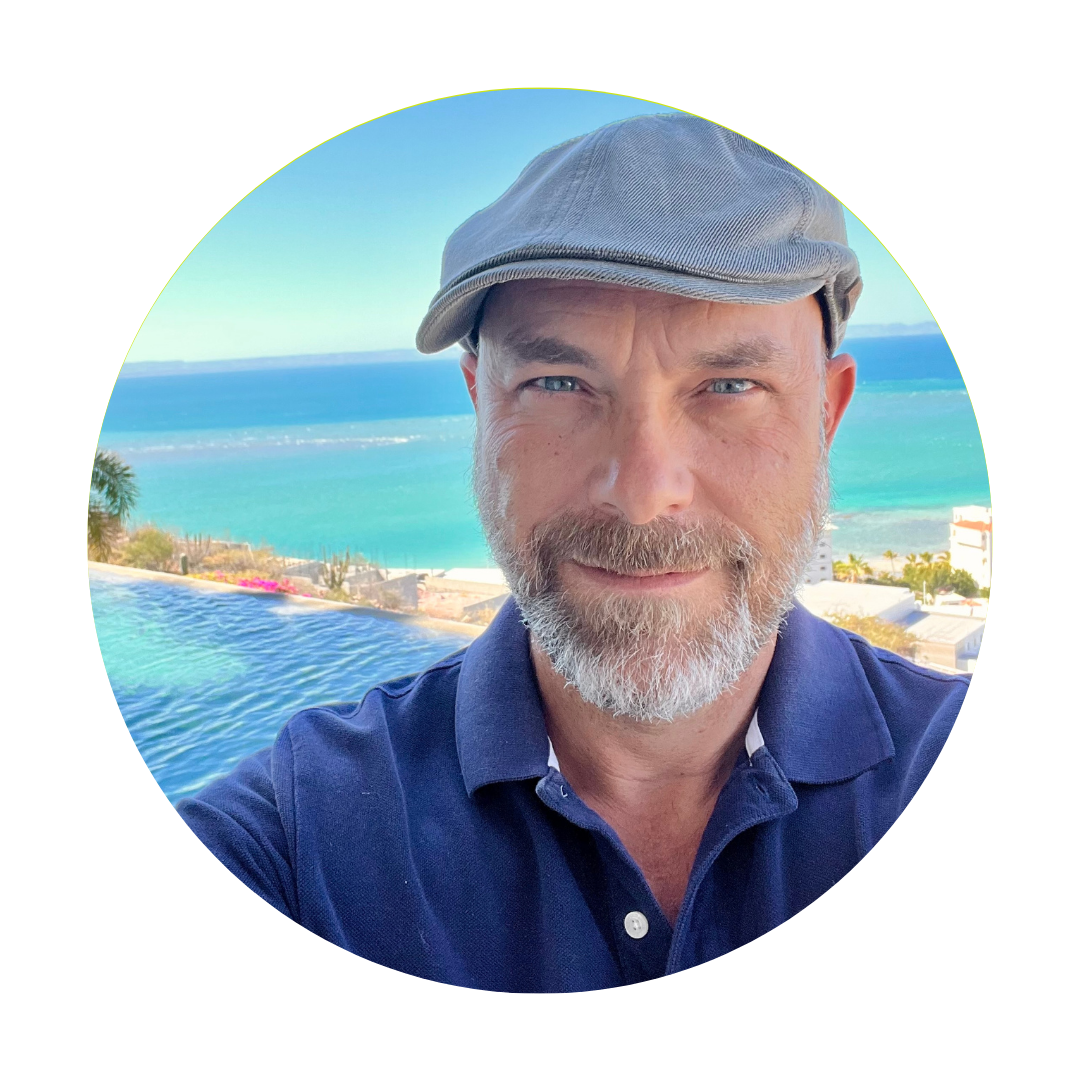
By Ian Wilson — Licensed Mexican Real Estate Broker, AMPI La Paz Board Member, La Paz Resident
I'm not going to give you the polished version of how foreigners buy property in Baja California Sur. You can find that on a hundred websites, and most of it is written by people who've never sat across the closing table from a nervous buyer in La Paz.
Instead, I'm going to walk you through it the way I've actually lived it — the real sequence, the numbers as they stand in 2026, and the specific places where I've watched buyers (and yes, occasionally a deal of my own) go sideways. If you're a US or Canadian buyer, retiree, or investor looking at BCS, this is the document I wish someone had handed me when I started.
Let's go step by step.
Step 1: Understand that in BCS, you almost certainly need a fideicomiso
Here's the first thing I tell every North American buyer, usually within the first ten minutes: the entire Baja peninsula sits inside Mexico's "restricted zone." Under Article 27 of the Mexican Constitution — on the books since 1917 — foreigners can't hold direct title to land within 50 kilometers of the coast or 100 kilometers of a border. BCS is coast on both sides. There is no "but my lot is far enough inland" exception here.
So foreigners buy through a fideicomiso — a bank trust. A Mexican bank holds legal title as trustee, and you are the beneficiary with the full right to use, rent, renovate, sell, and pass the property to your heirs. The trust runs 50 years and is renewable. It is not a loophole and it is not a lease. It's the legal structure Mexico built specifically to let foreigners invest here.
The first mistake I see: buyers who arrive convinced the fideicomiso means they "don't really own" the property, and either walk away from a great property or, worse, get talked into something riskier to avoid it.
One of my clients almost walked away from buying in Baja because of one word: fideicomiso. He had heard that a Mexican bank would “own” the property and was convinced he could lose everything if the bank failed or the government changed the rules. For weeks, he compared it to a lease, a timeshare, and every other structure he didn’t fully trust. What finally changed his mind wasn’t a sales pitch—it was understanding the facts. A fideicomiso has been the legal framework used by foreign buyers for decades in Mexico’s coastal and border regions. The bank acts only as trustee, while the buyer retains the rights to use, remodel, rent, sell, mortgage, and pass the property to heirs. The moment he realized that tens of thousands of Americans and Canadians successfully own beachfront property through the same structure—and that the trust was specifically designed to protect foreign ownership, not limit it—his fear disappeared. Today, he tells me the fideicomiso wasn’t the risk; not understanding it was.
It all worked out ;)
If you're buying multiple properties or something purely commercial, a Mexican corporation can be the better structure. That's a conversation, not a default — I'll tell you straight which one fits.
Step 2: Meet the Notario — and unlearn the US escrow model
This is where most of my American and Canadian clients get genuinely confused, so I address it early.
In the US and Canada, a title or escrow company quietly runs the closing in the background. In Mexico, the central figure is the Notario Público — a government-appointed legal authority, not a clerk who stamps documents. The Notario verifies title, runs the lien and debt searches, calculates and collects the taxes, drafts the official deed (the escritura), and registers the transaction. Their authority is real and their role is non-negotiable.
I remember a Canadian buyer who became visibly frustrated when he learned the Notario was requesting additional documentation and that closing couldn’t proceed until every search and verification was complete. “This isn’t how we do it back home,” he told me. In his mind, the process felt slow and overly bureaucratic. A few weeks later, the reason became clear. During the Notario’s review, an unresolved issue surfaced involving prior municipal records that could have created headaches after closing. The Notario required the seller to resolve it before the deed could be transferred. My client wasn’t thrilled about the delay, but he was very happy not to inherit someone else’s problem. After the transaction closed, he told me something I still remember: “Back home, I probably never would have known about that issue until it became my issue.” That’s when many foreign buyers realize the Notario isn’t an obstacle to the transaction—it’s one of the most important protections built into it. When you understand the role they play, the process starts to feel a lot less intimidating and a lot more reassuring.
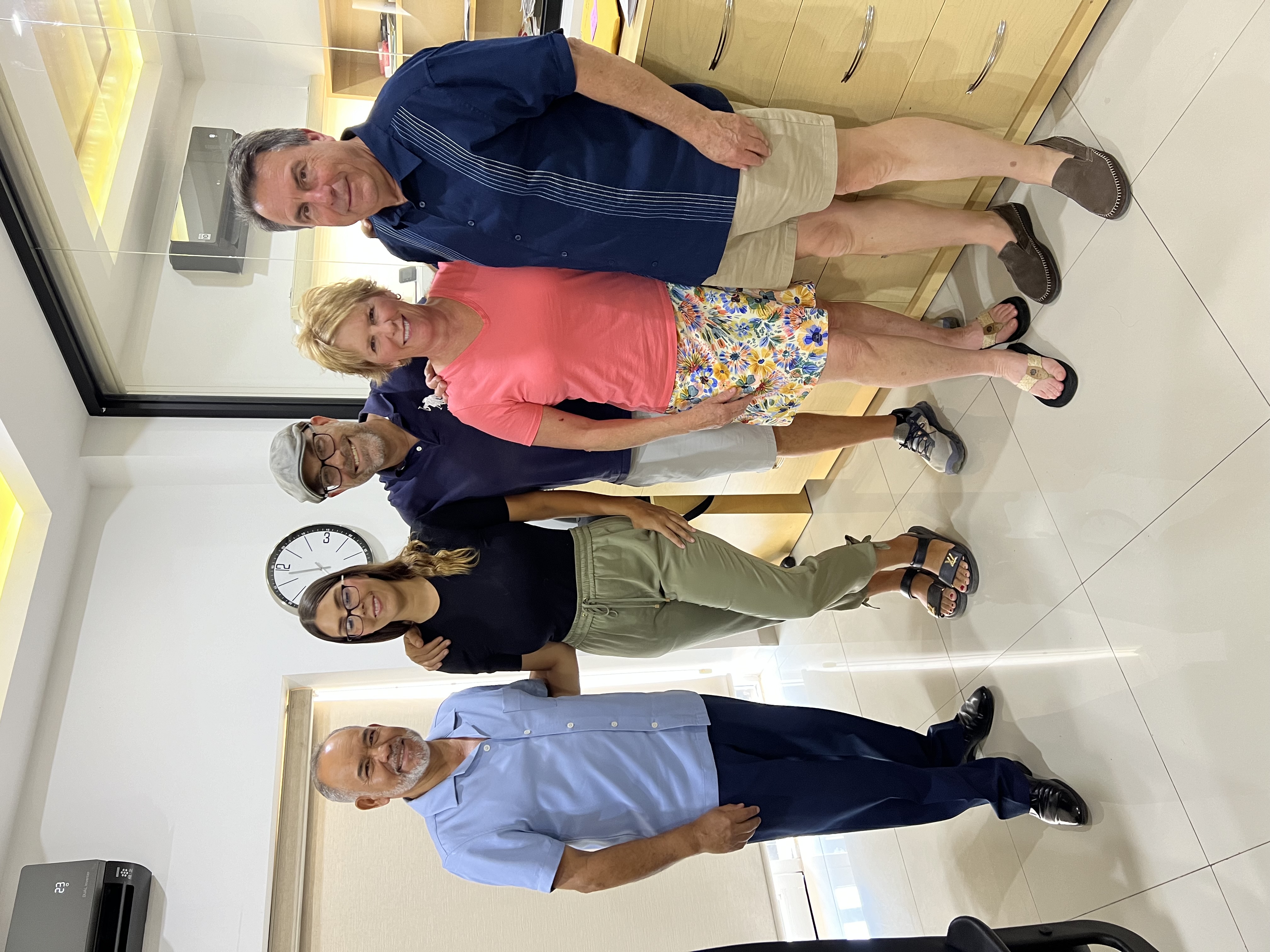
A happy closing with Dream Baja Realty and Jose Gaytan & Associates in La Paz, BCS
Step 3: Due diligence — where the expensive failures actually happen
If something goes wrong in a BCS purchase, it almost always goes wrong here. The legal due diligence covers title search, liens, no-debt certificates from utilities, condo bylaws, zoning, and the appraisal. But two traps deserve their own warning.
The ejido trap. This is the number one way foreigners lose money in Mexico, full stop. Ejido land is communal agrarian land that cannot be legally sold to a foreigner through a normal title — yet it gets marketed to outsiders constantly, often at prices that look too good to be true because they are. A property has to be fully "regularized" into private title before it can go into a fideicomiso. I check this on every single deal, no exceptions.
A few years ago, a buyer came to me after falling in love with an ocean-view parcel that was being marketed privately at a price well below market value. He was ready to wire a substantial deposit because, on the surface, it looked like the deal of a lifetime. The problem? The land was still ejido. The seller assured him that “everyone buys this way” and that the paperwork could be sorted out later. Before he sent the money, I insisted we verify the property’s legal status. Sure enough, there was no private title, no escritura, and no way for a foreigner to legally acquire ownership through a fideicomiso in its current form. Had he moved forward, he would have risked more than $150,000 USD on a transaction that could have bought him nothing but years of legal uncertainty and a very expensive lesson. The property may eventually become regularized, and some ejido transactions do successfully make that transition, but “eventually” is not a legal strategy. To this day, whenever someone tells me they’ve found a bargain that seems too good to be true, the very first thing I ask is: “Is it titled, or is it ejido?” That single question has saved my clients hundreds of thousands of dollars over the years.
Underreporting the purchase price. Buyers are sometimes told they can "save" on the acquisition tax by recording a lower price on the deed. Don't. You'll save a little now and hand yourself a far larger capital gains bill when you sell, because your gain is calculated from that artificially low base. I've watched this decision quietly cost sellers tens of thousands years later.
One more reality check: Mexican real estate is classified as a "vulnerable activity" under anti-money-laundering law (LFPIORPI), and the rules tightened again in 2025. Expect to provide ID, proof of funds, and documentation. It's normal, it applies to everyone, and trying to shortcut it is how closings stall.
Step 4: The numbers — what BCS actually costs in 2026
This is the section buyers screenshot, so let me give you the real figures as they stand right now.
Acquisition tax (ISABI): 3% of the taxable value. This is the big one, and it just changed. As of January 1, 2026, BCS harmonized the rate across all five municipalities — including La Paz, where I live and work — at 3%, up from 2%. It's now the same in Los Cabos, La Paz, Loreto, Comondú, and Mulegé. And it's calculated on the highest of three numbers: your purchase price, the cadastral value, or the bank appraisal — not whichever is lowest.
Fideicomiso setup: roughly $2,000–$3,000 USD, one time.
SRE permit (the federal permit to create the trust): about $1,000 USD.
Annual trust fee: roughly $500–$1,000 USD per year, ongoing, paid to the bank.
Public Registry fees: about 0.5%–1% of the value.
Notary fees, appraisal (avalúo), and certificates on top of that.
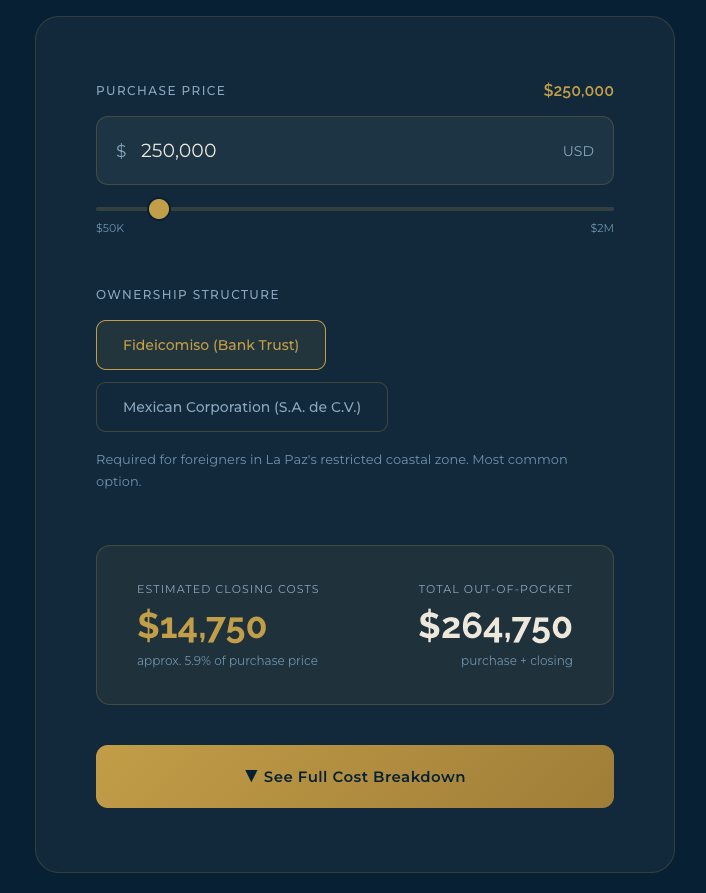
Add it up and foreign buyers in BCS should budget somewhere in the range of 4%–8% of the purchase price in closing costs, with smaller properties landing at the higher end because some fees are fixed. Budget for it before you make an offer.
Want to experiment with what your closing costs would be in Baja California Sur? Dream Baja Realty have a closing costs calculator on their site so that you don't have to wonder or guess: https://dreambajarealty.com/home-buyer - just scroll down the page and try not to get too distracted by looking at beautiful homes.
https://dreambajarealty.com/home-buyer
Ongoing, the only standing costs are your annual trust fee and predial (property tax), which is genuinely low here — typically around 0.1%–0.2% of assessed value. The "1% of the property value every year" rumor you may have read is simply false.
Step 5: Closing, the escritura, and protecting your family
At closing, the Notario finalizes and registers the escritura, the bank issues your trust, and the property is yours to use as you see fit. One step I never let a buyer skip: naming substitute beneficiaries in the fideicomiso. If you pass away, the property transfers directly to them — no Mexican probate, which can be slow and costly. It takes five minutes at signing and saves your family a nightmare later.
One of the most meaningful phone calls I’ve received came from the daughter of a former client. Years earlier, during the closing, I’d spent a few extra minutes explaining why naming substitute beneficiaries in the fideicomiso mattered. Like many buyers, her parents initially saw it as just another form to sign. After her father passed away unexpectedly, that simple decision spared the family from a lengthy and expensive probate process in Mexico. The property transferred according to his wishes, and the family was able to focus on each other instead of lawyers, court filings, and uncertainty. Her daughter called simply to say thank you. Most people think real estate is about finding the right property, but sometimes the most important conversations happen at the closing table. Five minutes of planning can save your family months—or years—of stress when they need peace the most.
What I'd tell you over coffee
The BCS buying process isn't risky because it's foreign. It's risky when it's rushed, when the price gets fudged to save a few pesos, or when someone skips the ejido check to close faster. Done properly — restricted-zone confirmed, ejido cleared, fideicomiso set up correctly, costs budgeted at 4%–8%, beneficiaries named — it is one of the most secure ways a North American can own a piece of this coast.
I've sat through the smooth closings and the messy ones, and the difference is almost never luck. It's having someone licensed and local in your corner before you sign anything.
If you're thinking about buying in La Paz or anywhere in BCS, send me a message or book a no-pressure call with Dream Baja Realty. Tell me where you're looking and what you're worried about — I'll give you the honest version, ejido warnings and all, before you spend a peso.
Ian Wilson is the founder and broker of Dream Baja Realty, a boutique real estate agency based in La Paz, BCS, Mexico. Originally from Victoria, BC, Ian brings over 25 years of international sales and marketing experience to the world of Baja real estate and currently serves as a board member of AMPI La Paz, the Mexican Association of Real Estate Professionals. Passionate about helping Americans and Canadians buy and invest in Mexico with confidence, Ian combines deep local knowledge, professional oversight, and a commitment to client success. Whether you’re relocating, retiring, or investing in Baja California Sur, Ian is here to help make your Baja dreams a reality.